Two years ago the job description for a "Principal AI Architect" was a paragraph stapled to a software-architect JD. Today it is a distinct, well-paid, and badly misunderstood role. Companies are hiring people to make a handful of decisions that will shape their AI estate for a decade — which foundation models to standardise on, where the AI gateway sits, who approves an agent that can move money — and the candidates who win those seats are not the ones who memorised the most model names. They are the ones who can defend a trade-off in front of a CFO, a CISO and a sceptical lead engineer in the same hour.
This article opens a twenty-part playbook written for senior engineers and architects preparing for that seat. Here I will show you what the role actually is (and is not), the competency model panels secretly score you against, how the interview loop is constructed, what a credible first ninety days looks like, and how the rest of the series is organised. Everything that follows assumes you already design production systems; what changes at principal level is the blast radius of your decisions and the number of people you must persuade without authority over any of them.
Executive Summary
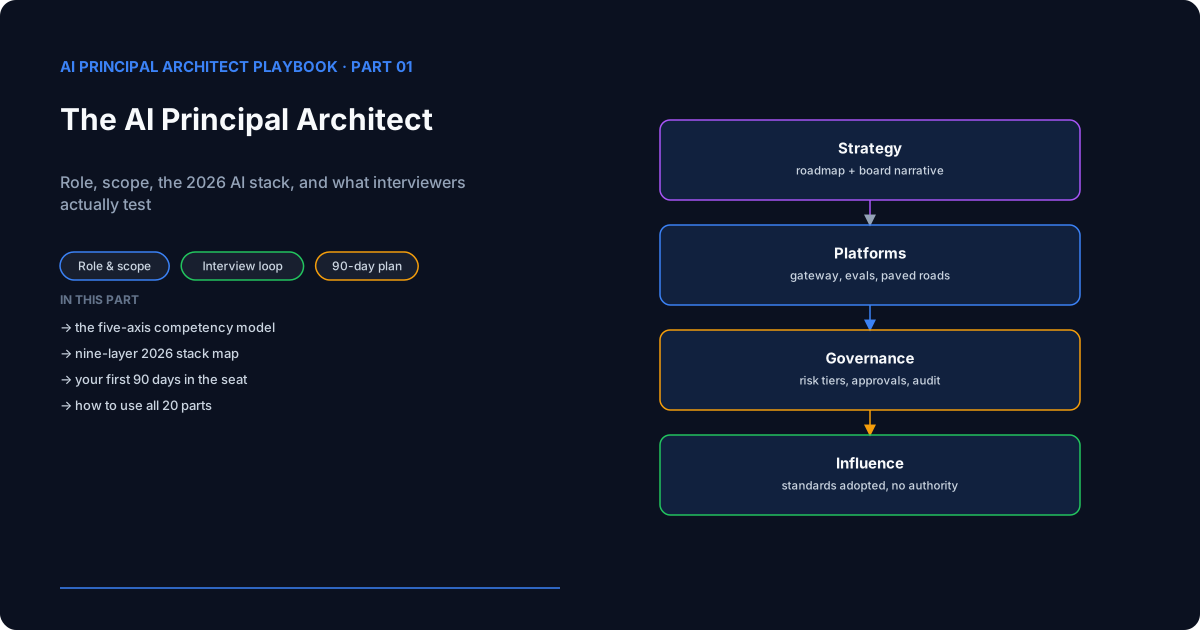
- The role sits at the intersection of strategy, platform engineering, governance and influence — it is not "senior engineer with more seniority".
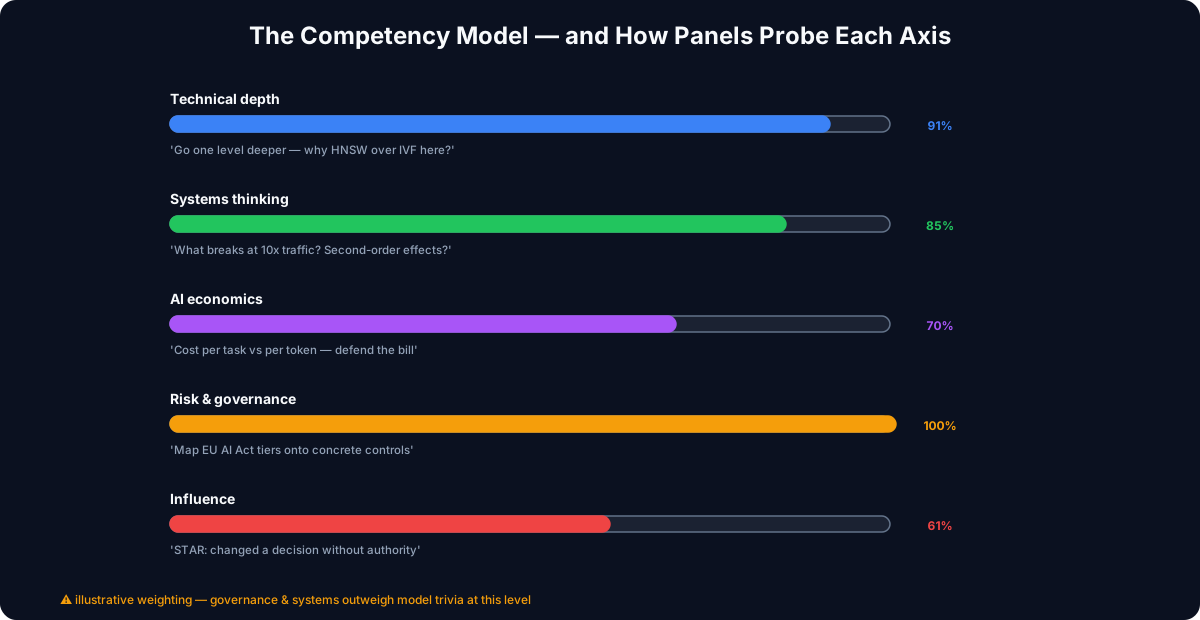
- You are judged on five axes: technical depth, systems thinking, AI economics, risk & governance, and influence. Most candidates over-invest in the first.
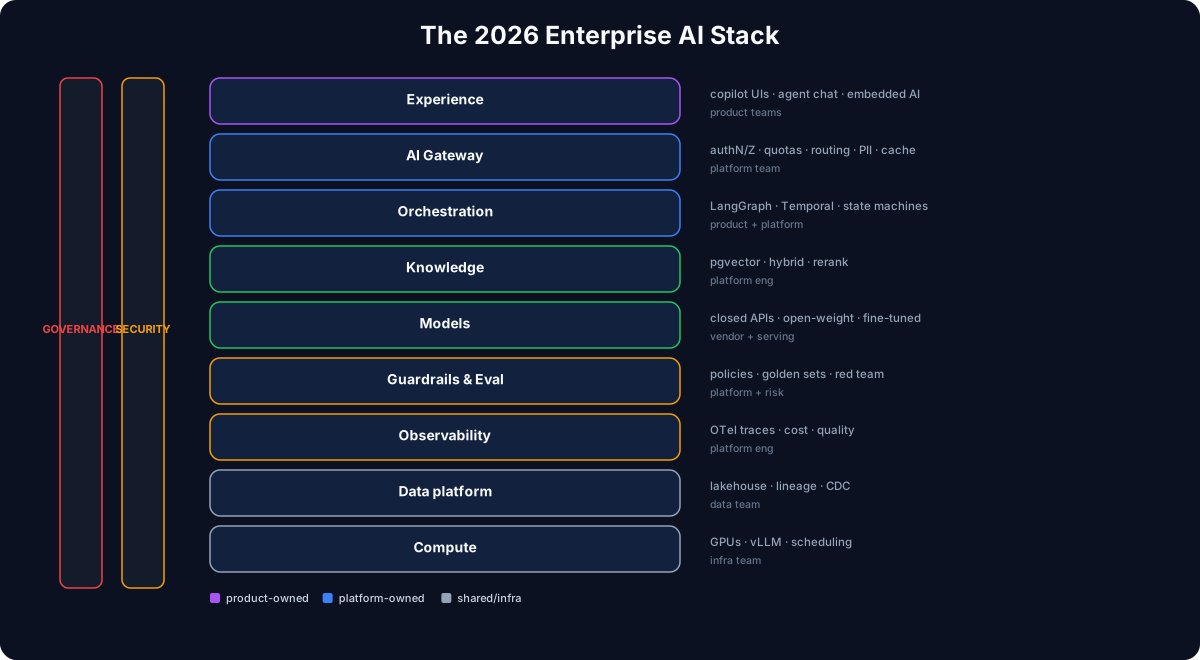
- The 2026 AI stack has nine layers; a principal owns the seams between them and the standards that keep them coherent.
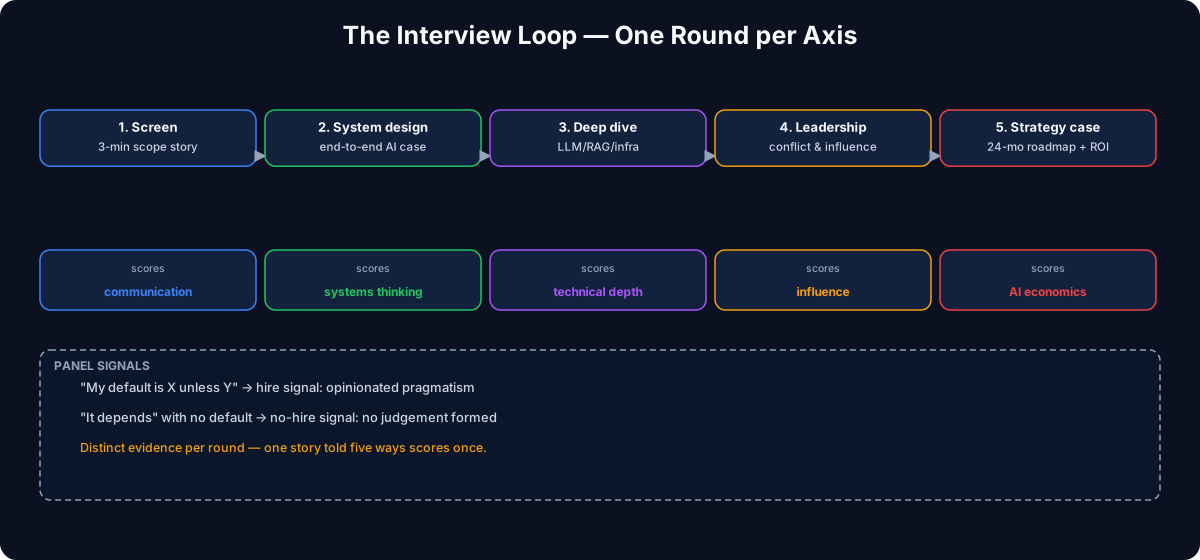
- Interview loops test each axis in a different round — prepare distinct evidence, not one story repeated five ways.
- A credible 90-day plan leads with listening and an AI inventory, not architecture diagrams.
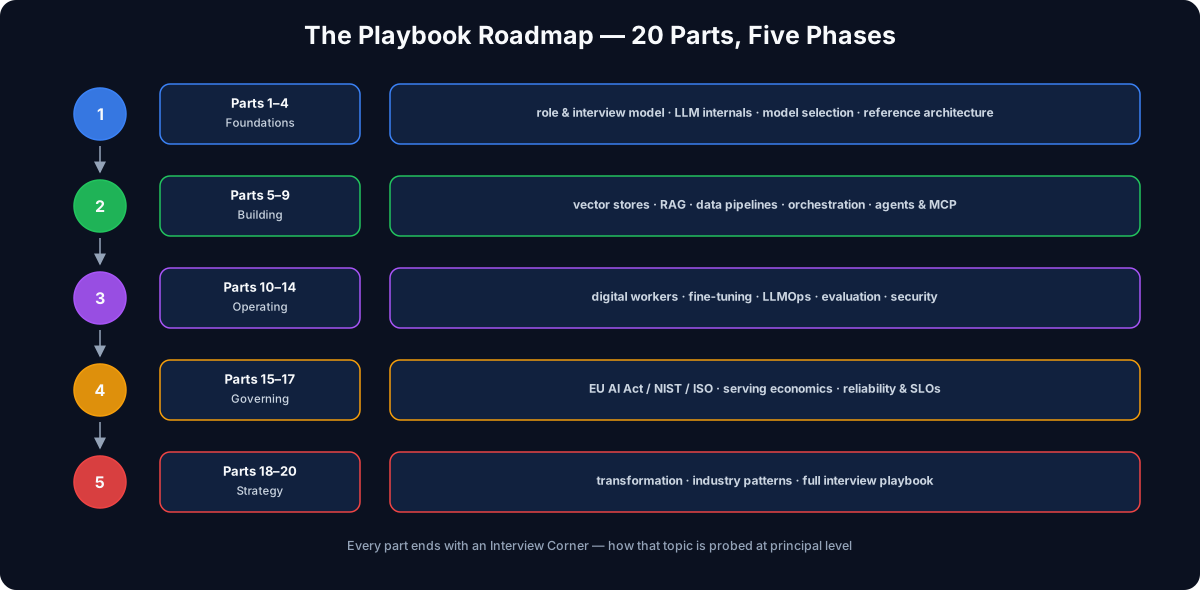
- This series builds the whole job in order: foundations → building → operating → governing → strategy and the interview.
1. What the Role Actually Is
Every large company I have seen converge on this role describes it the same way in private: the person who decides what "good" looks like for AI across the whole enterprise, and makes that decision stick. That sentence unpacks into four distinct mandates.
Strategy. You translate business ambition into an AI roadmap the board understands: which use cases, in what order, with what investment, defended by which numbers. When the CEO asks "why are we not doing what our competitor just announced", you are the answer — or the person who calmly explains why their demo is a liability in our regulatory perimeter.
Platforms. Individual product teams will build whatever is fastest for them. Your job is to make the fast path the right path: a shared AI gateway, a blessed retrieval stack, evaluation tooling, serving economics — the paved roads of Part 4, the reference architecture. You own the seams, not every component.
Governance. In a regulated industry this is not optional overhead, it is the licence to operate. Model inventory, risk tiering, human-in-the-loop requirements, documentation that survives an audit — Part 15 covers the frameworks, but the principal architect owns making them enforceable in the architecture, not in a PDF.
Influence. You have no direct reports in most orgs. Your decisions propagate through architecture review boards, written standards, reference implementations, and the quiet credibility of having run production before. If you cannot persuade, nothing else on this list matters.
2. Principal vs Senior vs Enterprise Architect
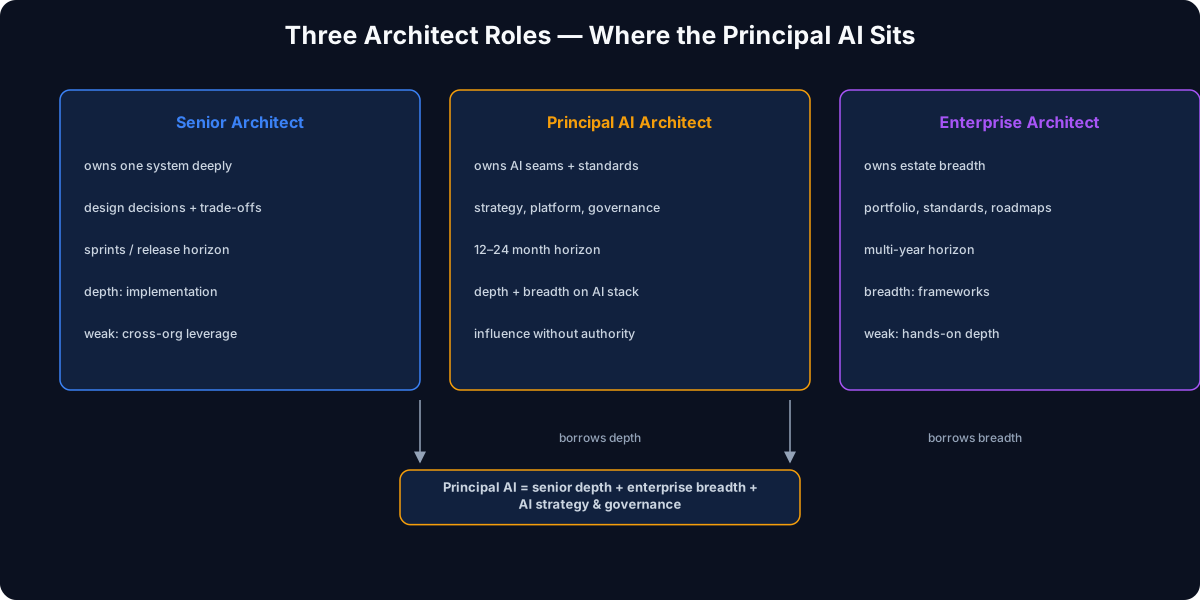
The confusion in interviews usually starts here, so let us pin it down. A senior architect owns one system deeply: its components, its failure modes, its cost profile. An enterprise architect owns breadth across the estate: standards, roadmaps, application portfolios — historically far from code. The principal AI architect is a hybrid that did not exist at scale before 2023: deep enough in AI/ML systems to argue about KV-cache sizing with an MLOps team, broad enough to decide how forty product teams share a gateway.
Two practical differences matter. First, time horizon: seniors think in sprints and releases, principals think in 12–24 month platform lifecycles — the model you standardise on this quarter has to survive being deprecated next year, which is exactly why Part 3 spends a chapter on vendor exit plans. Second, unit of output: your deliverables are decisions, standards, reference architectures and evaluations — not tickets. An enterprise architect who only draws boxes fails this job; a senior who only optimises one pipeline misses it entirely.
My rule of thumb when interviewing candidates: give them a conflict — a product team that wants to bypass the AI gateway "just this once". A senior answers with the technical risk. An enterprise architect answers with the policy. A principal answers with the escape hatch that makes the policy cheap to follow, and notes where the gateway is failing to serve the team. That third answer is the job.
3. The 2026 AI Stack You Will Be Judged On
Interviewers will probe whether your mental model of the stack is current. Here is the map this series uses — nine layers, each covered in depth later:
- Experience — copilots, agent UIs, embedded AI in products.
- AI Gateway — authentication, quotas, routing, PII redaction, caching. The single most under-built layer in most enterprises.
- Orchestration — workflows, agent loops, tool calling (Part 8, Part 9).
- Knowledge — RAG, vector stores, graphs (Part 5, Part 6).
- Models — closed APIs, open-weight, fine-tuned variants (Part 2, Part 3, Part 11).
- Guardrails & Eval — the quality and safety floor (Part 13, Part 14).
- Observability — traces, cost, quality signals (Part 17).
- Data platform — lakehouse, lineage, CDC feeding all of it (Part 7).
- Compute — GPUs, serving engines, scheduling (Part 16).
The insight interviewers are fishing for: the value is not in any layer, it is in the seams. Anyone can call an API. The architecture question is how a request flows through auth, policy, retrieval, a model, tools, and back — with a trace you can debug and a bill you can explain.
4. The Competency Model Behind Every Interview
Strip away the job-post adjectives and principal-level panels score five axes. Knowing them changes how you prepare.
Technical depth. Can you go one level deeper than the question? Ask about RAG and you should reach chunking trade-offs, rerankers and ACL trimming — not "we use a vector database". Part 2 and Part 5 exist because surface fluency in transformers and ANN indexes is now table stakes.
Systems thinking. Do you see second-order effects? Adding a cache layer changes correctness semantics; adding an agent changes your incident model. Panels test this with "what breaks at 10×" probes.
AI economics. The newest axis and the one most candidates flub. Cost per task, not cost per token. TTFT versus TPOT. When a small model behind a router beats a frontier model by 80% of spend for 97% of queries. Part 16 makes you dangerous here.
Risk & governance. In a bank this axis is half the job. Can you map the EU AI Act tiers, SR 11-7-style model risk, and OWASP LLM threats onto concrete controls? Vague talk of "responsible AI" scores zero.
Influence. Behavioural rounds hunt for evidence you moved organisations without authority: a standard you got adopted, a migration you led, a bad decision you killed diplomatically.
5. How the Interview Loop Is Structured
Principal loops are longer and more synthetic than senior ones. Expect five distinct rounds, each scoring a different axis:
- Screen — can you compress your scope into a coherent three-minute story? Rehearse it. "I own AI platform strategy for a 40-team org; I run the gateway, the model portfolio and the eval discipline" beats a ramble.
- AI system design — the flagship round. "Design an enterprise knowledge assistant for 50,000 employees" is the archetype; Part 20 works three full cases. They are scoring requirement-gathering, NFRs, and whether governance appears unprompted.
- Technical deep dive — they pick your claimed expertise and drill. If you list RAG, expect indexing pipeline questions; if serving, expect batching and quantisation.
- Leadership/behavioural — STAR stories for conflict, influence, failure. Prepare six and you cover 90% of variants.
- Strategy case — "the board wants an AI roadmap for 24 months" — portfolio thinking, ROI, operating model (Part 18).
The meta-skill they score across all five: opinionated pragmatism. "My default is X unless Y" — a stated default plus its exception conditions — reads as experience. "It depends" with no default reads as no experience.
6. Your First 90 Days in the Seat
The failure mode of new principals is shipping an architecture diagram in week two. The credible path is slower at the start and much faster by month three:
Days 1–30: map reality. Inventory every AI usage in flight — the sanctioned ones and the shadow ones, and assume shadow outnumbers sanctioned three to one. Interview team leads, read the incident history, tally the actual spend. Deliverable: an AI inventory with owners, models, data classes and risk tiers. This becomes your governance backbone later (Part 15).
Days 31–60: find the seams that bleed. Where do teams duplicate? Usually: six bespoke prompt pipelines, zero shared evals, and three different keys to the same model API. Pick one platform gap — the AI gateway is almost always the highest-leverage first build (Part 4) — and write a two-page RFC, not a forty-page blueprint.
Days 61–90: ship a paved road. Land the first version with one friendly product team as the lighthouse customer. Measure adoption, not perfection. Simultaneously stand up the architecture review habit: a weekly forum where AI-affecting designs get thirty minutes. Influence infrastructure is as important as the technical kind.
Throughout: keep a decision log. Every "we chose X over Y because Z" is interview evidence later and governance evidence always.
7. How to Use This Series
The twenty parts are sequenced so each builds the vocabulary the next assumes. Part 2 makes you fluent in LLM internals and inference economics; Part 3 turns that into model-selection judgement; Part 4 gives you the reference architecture everything else hangs on. Parts 5–9 build the systems — vectors, RAG, data pipelines, orchestration, agents. Parts 10–14 operate them — digital workers, fine-tuning decisions, LLMOps, evaluation, security. Parts 15–17 govern and scale — regulation, serving economics, reliability. Parts 18–20 close the loop — transformation strategy, industry patterns, and a full interview playbook with three worked system-design cases and a hundred questions.
Read in order if you have a month. Jump if you have a deadline — each part stands alone and cross-references its dependencies by title. The Interview Corner in every part shows you how that topic gets probed at principal level, which is worth reading even if you skip the rest.
Interview Corner
Q: How is the Principal AI Architect role different from an Enterprise Architect role?
Strong answer: "Enterprise architects optimise a broad estate for consistency; I do that too, but with hands-on depth in AI systems — I can debate HNSW parameters with the search team and then defend the model-risk posture to regulators. The differentiator is that AI changes so fast that static standards fail; my job is to build decision frameworks — gateways, evals, paved roads — that keep the estate coherent while the technology moves under us."
What the interviewer is really testing: whether you have the depth this role demands that traditional EA lacks, and whether you understand governance must live in architecture, not documents.
Q: A product team wants to call the model API directly, bypassing your gateway. What do you do?
Strong answer: "First, understand why — usually the gateway is missing something they need: a model, a latency target, a region. I fix the paved road rather than fight the bypass. If the bypass must exist short-term, I grant a time-boxed exception with logging obligations and a migration date. Direct vendor keys with no quota, no PII redaction and no audit is a hard no — not because of policy, but because the incident review afterwards will be brutal."
What the interviewer is really testing: influence without authority, and whether you treat standards as a service to teams rather than a wall.
Q: Walk me through how you would build an AI platform strategy for a company just starting out.
Strong answer: "Inventory first — what is already running, sanctioned or not. Then pick the control plane: an AI gateway with auth, quotas, routing and audit is the highest-leverage first platform because everything else standardises through it. Parallel track: two lighthouse use cases chosen on value-versus-feasibility, not on executive enthusiasm. Then the operating model — a small platform team plus product teams building on the paved road. I would expect a working gateway and one use case in production within two quarters, or I am going too slow."
What the interviewer is really testing: sequencing and pragmatism — do you start with infrastructure or use cases, and can you defend the answer.
Q: What is the biggest risk in enterprise AI adoption right now?
Strong answer: "Unmeasured quality at scale. We are shipping systems whose failure mode is confident wrongness, into processes that assumed deterministic software. The mitigation is an evaluation discipline — golden sets, quality SLOs, production monitoring of groundedness — built before scale, not after the incident. Shadow AI is a close second: if the paved road is harder than a personal API key, governance loses."
What the interviewer is really testing: whether you think in failure modes and controls, not just capabilities.
Q: Tell me about a time you influenced an architecture decision without authority.
Strong answer: Have one STAR ready from your real career. Structure it: the stalemate, the evidence you built (usually a costed comparison or a prototype), the coalition you built team by team, and the outcome with a number. In my experience the winning move is almost always making the right path demonstrably cheaper than the wrong one — architects persuade with measured comparisons, not seniority.
What the interviewer is really testing: concrete evidence of the influence axis — the scarcest skill at this level.
Q: How do you keep technical credibility while operating at strategy level?
Strong answer: "Deliberately. I keep one hand in the stack — I run reference implementations, do the occasional deep-dive review, and read the failure post-mortems of our own systems. And I spend a fixed slice of time on primary sources: release notes, papers, postmortems from companies running AI at scale. Credibility with senior engineers is the currency that buys influence; once teams suspect you only read strategy decks, your standards become decoration."
What the interviewer is really testing: self-awareness about the depth/breadth tension inherent to the role.
Key Takeaways
- Principal AI Architect = strategy + platforms + governance + influence. Depth alone does not qualify you.
- Own the seams of the nine-layer stack, not every component — the value is in how requests flow through it.
- Prepare interview evidence per competency axis; "it depends" is a failed answer, "default X unless Y" is a passing one.
- The first 90 days: inventory, find the bleeding seam, ship one paved road with a lighthouse team.
- Shadow AI is a platform failure, not a people failure — make the governed path the easy path.
Frequently Asked Questions
Do I need to have trained models to get this job?
No. You need to reason about models — their cost curves, failure modes, evaluation and serving — and to have run production systems. Most principal AI architects have never pre-trained anything; many have never fine-tuned either. You do need to know when fine-tuning is the wrong answer (Part 11).
Is the role more technical or more managerial?
It is a technical leadership role, not people management — but it fails without persuasion skills. Think of it as: deep enough to be credible to staff engineers, broad enough to be useful to a CIO.
What background do principal AI architects come from?
Mostly three paths: platform/infrastructure architects who went deep on AI, ML engineers who grew breadth and communication skills, and solution architects in regulated industries who learned the ML layer. All three can work; the common denominator is production scars.
How big a company needs this role?
The full-time version appears once you have five-plus teams building AI features, regulatory exposure, or a seven-figure annual AI bill. Below that, it is a part-time hat on a senior architect — which is a fine way to grow into it.
What is the single best preparation for the interview?
Build a defensible opinion on every major seam of the stack — gateway vs none, RAG vs fine-tune, closed vs open, build vs buy — each with a stated default and its exceptions. Panels hire judgement, not recall.
Further Reading
- Attention Is All You Need — the transformer paper; read it once, understand the intuition forever.
- NIST AI Risk Management Framework 1.0 — the Govern/Map/Measure/Manage vocabulary interviews assume.
- OWASP Top 10 for LLM Applications — the threat list a principal should know cold.
- SR 11-7: Model Risk Management — banking model-risk guidance that now shapes AI governance everywhere.
- Model Context Protocol (Anthropic) — the tool-integration standard covered in Part 9.