

By 2026, the patent offices in the United States, Europe, China, Japan, and South Korea are receiving more AI and robotics applications than almost any other technology class. The reason is simple: the businesses that control the underlying methods for how machines perceive, reason, decide, and act will own the next industrial layer. A patent is not just a certificate — it is a legal monopoly on a technical solution for up to 20 years, a signal to investors, and a defensive wall against copycats.
But not every idea in AI and robotics is patentable. Patents protect specific technical solutions to technical problems. An abstract algorithm, a business method, or a purely aesthetic design may fail examination. The strongest filings in this field describe a novel combination of hardware, software, data preparation, and control logic that produces a measurable improvement — lower latency, higher accuracy, safer interaction, or new capability.
In this guide, we look at ten of the most valuable, patentable areas in AI and robotics today. Each section includes a real-world case study, the technical claims to focus on, market benefits, and common mistakes to avoid. We also provide references to white papers and institutional reports at the end.
How to Read This Guide: The Patent Value Matrix
Before diving into the list, use this simple 2x2 matrix to decide where to spend your patent budget. The horizontal axis is commercial market value: how much revenue can the invention protect or generate? The vertical axis is technical moat: how hard is it for a competitor to design around the patent?
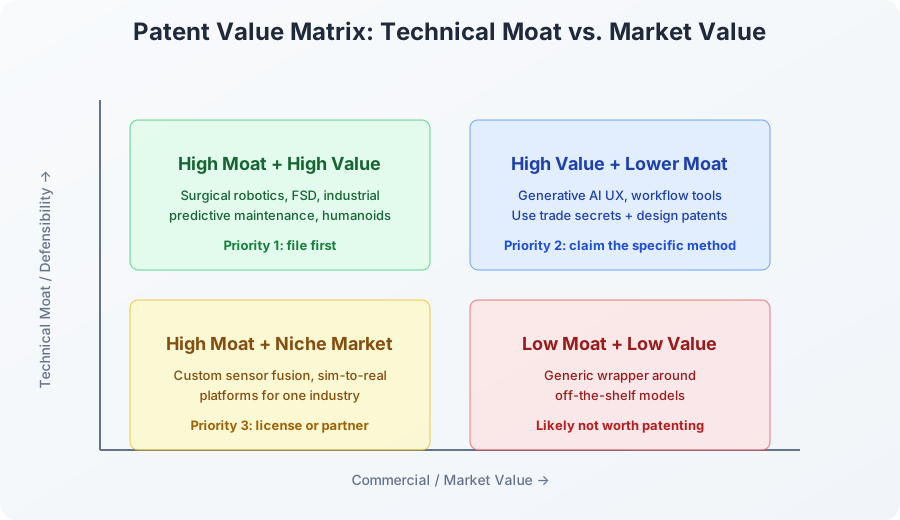
Premium patent territory is the top-right quadrant: high technical defensibility and high commercial value. Many generative-AI user interfaces sit in the top-left (high value, low moat), while narrow industrial sensors sit in the bottom-right (low value to a consumer, high moat inside a specific supply chain). Your portfolio should be weighted toward the top-right, with a few strategic bets in the other quadrants.
1. Novel Generative AI Model Architectures
You cannot patent the output of a generative AI model. What you can patent is the technical method for producing that output: a new transformer block, a more efficient attention mechanism, a diffusion sampling schedule, a quantization recipe, or a domain-specific fine-tuning pipeline. The strongest patents describe the full system — data selection, model architecture, training objectives, and inference optimization — as an integrated whole.
Real-world example: OpenAI and Google DeepMind file thousands of patent applications around transformer architectures, mixture-of-experts routing, and reinforcement learning from human feedback. These filings rarely claim "a chatbot" in the abstract. Instead, they claim the specific way attention heads are grouped, how expert routers are trained, or how synthetic data is filtered before training. That is the level of detail that survives examination.
What to patent:
- New attention mechanisms that reduce quadratic complexity
- Diffusion model schedulers that improve sample quality at fewer steps
- Quantization and distillation methods that preserve long-context reasoning
- Synthetic data generation and filtering pipelines for a target domain
Market benefit: A strong model-architecture patent can become a licensing asset, especially if your method becomes a standard for on-device or edge inference where compute is limited.
2. Embodied AI Control Systems
Embodied AI is the bridge between a foundation model and a physical robot. The patentable idea is usually not the model itself but the control system that turns model outputs into safe, reliable motion. This includes natural-language-to-motion planners, real-time replanning loops, and memory-augmented controllers that learn from previous attempts.
Real-world example: Google DeepMind's RT-2 and newer RT-X work show that a single vision-language-action (VLA) model can control multiple robot types. The patentable portion is not just the VLA model but the way high-frequency control commands are decoded from low-frequency model outputs, and how the system falls back to a safety policy when uncertainty is high.
What to patent:
- Policies that translate language instructions into end-effector trajectories
- Hierarchical control: high-level planner + low-level reactive controller
- Uncertainty-aware action rejection and safety-policy switching
- Cross-embodiment transfer: one policy for multiple robot morphologies
Market benefit: Embodied AI is the core of general-purpose robots. A defensible controller patent makes your robot compatible with new tasks without retraining from scratch, which is the difference between a tool and a platform.
3. Sim-to-Real Transfer Learning Pipelines
Training in simulation is cheap, but the real world is noisy. The patentable idea is a domain transfer pipeline that closes the gap without expensive real-world retraining. This is one of the hardest problems in robotics, and solutions are highly valuable.
Real-world example: Tesla's Full Self-Driving team uses massive simulation to train neural networks before deploying them in vehicles. Their patent portfolio includes methods for domain randomization, sensor noise modeling, and automatic scenario generation. Similarly, Boston Dynamics trains Atlas and Spot control policies in simulation and uses specialized adaptation layers to transfer them to hardware.
What to patent:
- Domain randomization distributions tuned to real-world sensor statistics
- Adaptation networks that adjust a sim-trained policy online
- Physics-informed synthetic data generators
- Reality gap metrics and automatic retraining triggers
Market benefit: Sim-to-real reduces the cost and risk of deploying robots in unstructured environments. If your method works, it becomes a core component of every product line that uses simulation.
4. Multi-Modal Perception and Sensor Fusion
Reliable robots do not rely on a single sensor. They fuse vision, LiDAR, radar, tactile, audio, and proprioception into one coherent model of the world. The patentable idea is the specific fusion method that improves localization, object recognition, or scene understanding in a measurable way.
Real-world example: Autonomous vehicle companies like Waymo and Tesla have extensive patent portfolios on sensor fusion. Waymo's long-range LiDAR plus camera fusion for object tracking, and Tesla's occupancy networks that fuse multiple camera views into a 3D scene representation, are both patentable because they solve a concrete perception problem with a specific architecture.
What to patent:
- Calibration-free or self-calibrating sensor fusion
- Uncertainty-weighted fusion of heterogeneous sensors
- Edge-compatible fusion networks with fixed-point arithmetic
- Tactile-visual fusion for manipulation and slip detection
Market benefit: Perception is the safety bottleneck in mobile robots, cars, drones, and surgical systems. A reliable fusion patent is valuable for licensing across multiple industries.
5. Adaptive Robotic Grasping and Manipulation
Grasping arbitrary objects remains one of the unsolved problems in robotics. The strongest patentable ideas in this space combine novel hardware with learning-based control: soft grippers, variable-stiffness fingers, in-hand reorientation, and dual-arm manipulation strategies.
Real-world example: Amazon Robotics and Covariant have invested heavily in warehouse picking. Covariant's RFM-1 foundation model for robotics is trained on real picking data and can generalize to objects it has never seen. The patentable part is the combination of the gripper design, the vision system, and the grasp planning policy that handles deformable, transparent, and fragile items.
What to patent:
- Soft pneumatic or tendon-driven grippers with variable stiffness
- Grasp pose detection networks trained on synthetic + real data
- In-hand reorientation and regrasping algorithms
- Dual-arm collaborative manipulation for large or flexible objects
Market benefit: Warehouse automation, food handling, recycling, and manufacturing all need better manipulation. A patent here directly protects product-market fit.
6. Human-Robot Collaboration Safety Frameworks
As robots work next to people, safety becomes both a product feature and a regulatory requirement. Patentable inventions include predictive collision avoidance, dynamic force limiting, safe stop trajectories, and intent recognition that allow the robot to slow down or pause before a human enters a danger zone.
Real-world example: Universal Robots built its business on ISO/TS 15066-compliant collaborative robots. Their patents and those of competitors cover force-sensing joints, speed-and-separation monitoring, and hand-guiding modes. The technical value is that the robot can operate at full speed when alone and automatically reduce speed when a worker approaches.
What to patent:
- Human skeleton tracking and intent prediction from cameras or wearables
- Dynamic force/torque limits based on proximity and object stiffness
- Safe stop trajectories that minimize kinetic energy in milliseconds
- Workspace monitoring with 3D zones that adapt to task context
Market benefit: Safety patents reduce liability, speed up factory certification, and open markets like healthcare and elder care where human contact is unavoidable.
7. Autonomous Navigation in Dynamic Environments
Mobile robots in warehouses, hospitals, and streets must navigate around people, vehicles, and other robots. The patentable idea is a path-planning or behavior-prediction algorithm that handles dynamic obstacles better than existing methods.
Real-world example: Locus Robotics and 6 River Systems build autonomous mobile robots for warehouses. Their patents cover multi-agent path planning, congestion prediction, and elevator integration. Starship Technologies and Nuro have patents on sidewalk and road navigation with social conventions, such as yielding to pedestrians and queuing at crossings.
What to patent:
- Multi-agent path planning with deadlock prevention
- Pedestrian and vehicle trajectory prediction
- Social navigation policies that follow implicit traffic rules
- Beacon-free indoor localization across multiple floors
Market benefit: Navigation is a commodity until it is not. The differentiator is reliability in crowded, dynamic environments. A strong patent makes your system the one customers trust at scale.
8. Swarm Robotics Coordination Algorithms
Swarms of simple robots can clean, map, farm, or deliver faster than one large robot. The patentable idea is the coordination method: decentralized consensus, task allocation, fault-tolerant communication, and scalable formation control.
Real-world example: Harvard's Kilobot project and Blue River Technology's See & Spray system use swarm-like approaches. In industry, Amazon's Kiva system uses a central planner, while newer research focuses on decentralized swarms that keep working when individual units fail. Companies like SwarmFarm Robotics and Naïo Technologies patent agricultural swarm behaviors for weeding and planting.
What to patent:
- Decentralized consensus with limited communication range
- Dynamic task allocation based on local sensor data
- Fault-tolerant reconfiguration after unit loss
- Communication-efficient map merging for large-scale exploration
Market benefit: Swarm patents are especially valuable in agriculture, defense, and environmental monitoring, where redundancy and coverage area matter more than individual precision.
9. Surgical Robotics with Haptic Feedback and AI Vision
Surgical robotics combines precision mechanics with intelligent perception. Patentable areas include AI-enhanced tissue segmentation, tremor suppression, force-feedback teleoperation, and suturing trajectory planning.
Real-world example: Intuitive Surgical, the maker of the da Vinci system, owns more than 4,000 patents globally. Its portfolio covers teleoperated manipulators, wristed instruments, and vision systems. Newer entrants like CMR Surgical, Medtronic's Hugo, and Johnson & Johnson's Ottava are building patent walls around haptic feedback, autonomous suturing, and AI-based tissue classification.
What to patent:
- Real-time tissue segmentation and vessel detection
- Surgeon tremor suppression and motion scaling
- Haptic feedback that maps tissue resistance to the surgeon's hands
- Autonomous suturing and knot-tying trajectories
Market benefit: Surgical robotics is a high-margin, heavily regulated market. A patent portfolio is almost a prerequisite for fundraising and partnership discussions with hospitals and medical device distributors.
10. AI-Driven Predictive Maintenance for Industrial Robots
Unplanned downtime in factories is expensive. Predictive maintenance systems that use vibration analysis, thermal imaging, motor current signatures, and digital twins to forecast failures before they happen are highly patentable.
Real-world example: Siemens, ABB, KUKA, and Fanuc all offer predictive maintenance services for their robots. ABB's Ability Digital Twin and Siemens' Senseye use machine learning on sensor data to predict bearing wear, gear fatigue, and cable degradation. The patentable part is the failure model and the data-collection method that makes it accurate.
What to patent:
- Multi-sensor digital twin models of robot kinematics
- Failure-signature detection from motor current and vibration
- Remaining useful life (RUL) estimation with uncertainty bounds
- Maintenance scheduling optimization across a robot fleet
Market benefit: Predictive maintenance is a service business. If your patent protects the best failure-prediction model, you can license it per robot or sell it as a recurring software subscription.
Deep Dive: Three Case Studies
Case Study A: Boston Dynamics — From Dynamic Control to Commercial Robotics
Boston Dynamics has shown that the patent value in robotics is not the mechanical design alone, but the control system that makes it behave. Atlas can run, jump, and flip not because of better motors, but because of model-predictive control and reinforcement learning that plan contact forces in real time. Their patent strategy covers both the hardware configurations and the control policies, making it difficult to copy the robot's movement without infringing on the methods that generate it.
Lesson for founders: If your robot does something physically impressive, file claims on both the mechanism and the control loop. The mechanism may be copied; the control policy is much harder to design around.
Case Study B: Intuitive Surgical — The Moat of a Platform
Intuitive did not just patent the da Vinci arm. It patented the entire surgical workflow: the console, the instruments, the vision cart, the sterilization process, and the training simulator. This created a platform moat: hospitals switching to a competitor would have to retrain surgeons, replace instruments, and redesign workflows. The patents protect each layer of that stack.
Lesson for founders: Build a portfolio around the workflow, not the widget. Patent the data pipeline, the human interface, and the accessories that make your core invention useful.
Case Study C: Tesla — Hardware, Software, and Data
Tesla's robotics and AI strategy is a textbook example of a full-stack patent portfolio. For Full Self-Driving, it patents the neural network architectures, the data collection system, the simulation platform, and the in-car inference hardware. For Optimus, it is building patents around humanoid kinematics, actuators, and training data pipelines. The value comes from the closed loop between real-world data, simulation, and model improvement.
Lesson for founders: Your biggest moat may not be the algorithm but the data and infrastructure that feed it. Patent the data engine, the labeling pipeline, and the deployment system, not just the model.
Common Mistakes That Kill AI and Robotics Patents
Many strong inventions fail patent examination because of avoidable mistakes:
- Claiming the output, not the method. "A robot that folds laundry" is not patentable. "A control system that detects garment type from a depth image and selects a folding trajectory" is.
- Over-broad claims. "A neural network that does X" is likely rejected as an abstract idea. Be specific about the architecture, data, and training procedure.
- Poor prior-art search. AI and robotics move fast. A thorough search of arXiv, IEEE Xplore, USPTO, EPO, and WIPO databases before drafting can save thousands in rejection costs.
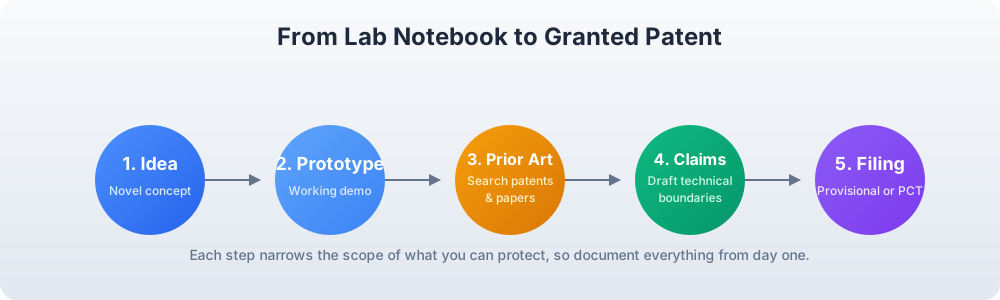
- Late filing. Most jurisdictions are first-to-file. If you disclose publicly before filing, you may lose rights. File a provisional application before launch or demo.
- Ignoring international markets. A U.S. patent does not protect you in Europe or China. Use the Patent Cooperation Treaty (PCT) within 12 months of the first filing.
How to Build a Filing Roadmap
A useful patent strategy for an AI or robotics startup has three layers:
Layer 1: Core Invention
File a provisional application as soon as you have a working prototype and a clear technical description. This locks in your priority date and gives you 12 months to refine the non-provisional claims.
Layer 2: Defensive Thicket
File continuation applications that cover variations, improvements, and alternative embodiments. If a competitor can tweak one parameter and avoid your claim, your patent is too narrow.
Layer 3: Commercial Adjacencies
Patent the data pipeline, the user interface, the training workflow, and the deployment architecture. These are often easier to detect and enforce than the core model.
When You Should Not Patent
Patents are not always the right tool. If your advantage comes from a proprietary dataset, customer relationships, or network effects, consider trade secrets instead. A patent requires public disclosure, which may help competitors more than it protects you. Use trade secrets for training data, fine-tuned weights, and customer-specific model adaptations that are hard to reverse-engineer.
References and Further Reading
- WIPO. (2019). Technology Trends 2019: Artificial Intelligence. World Intellectual Property Organization. This report tracks the surge in AI patent filings since 1950 and identifies transportation, healthcare, and agriculture as the top application fields.
- USPTO. (2024). Inventing AI: Tracing the diffusion of artificial intelligence with U.S. patents. United States Patent and Trademark Office. The report maps how AI patenting has spread across technology subclasses and industries.
- Stanford HAI. (2024). AI Index Report. Stanford Institute for Human-Centered Artificial Intelligence. Provides annual data on AI research, patents, investment, and deployment.
- MIT Technology Review. (2023-2024). Ongoing coverage of embodied AI, foundation models for robotics, and humanoid systems.
- IEEE Robotics & Automation Society. Technical standards and conference proceedings on sensor fusion, SLAM, manipulation, and human-robot interaction.
- ISO/TS 15066:2016. Collaborative robots — Safety requirements. International Organization for Standardization. Defines the safety requirements for cobots working alongside humans.
- Brookings Institution. (2023). AI and the workforce: A global perspective. Analysis of robotics and automation adoption and policy.
- Boston Dynamics public patent portfolio (USPTO, Google Patents). Search for "Boston Dynamics Systems and Methods for Robots."
- Intuitive Surgical. Investor and patent filings. The company reports more than 4,000 patents and patent applications globally related to surgical robotics.
- Tesla, Inc. Public patent and application records for FSD neural networks, Optimus humanoid systems, and battery/electronics integration.
Conclusion
The teams that will define the next decade in AI and robotics are not just building better models or faster motors. They are building defensible technical systems where the hardware, software, data, and control logic work together. Patent protection is how you turn that technical advantage into a business moat.
Start with the highest-value, highest-moat ideas: embodied control, sim-to-real, multi-modal perception, surgical robotics, and predictive maintenance. Document your invention from the first working prototype. Do a rigorous prior-art search. And work with a patent attorney who understands both the code and the machine. The right patent is not a cost — it is an asset that increases your valuation, protects your product, and gives you leverage in every future deal.
Take the next step
If you are building in AI or robotics, do a 30-minute patent audit this week: list your three most technically novel systems, identify the measurable improvement they create, and search WIPO and USPTO for the closest prior art. That single exercise will tell you where your strongest patent opportunities are before you spend money on filing fees.