
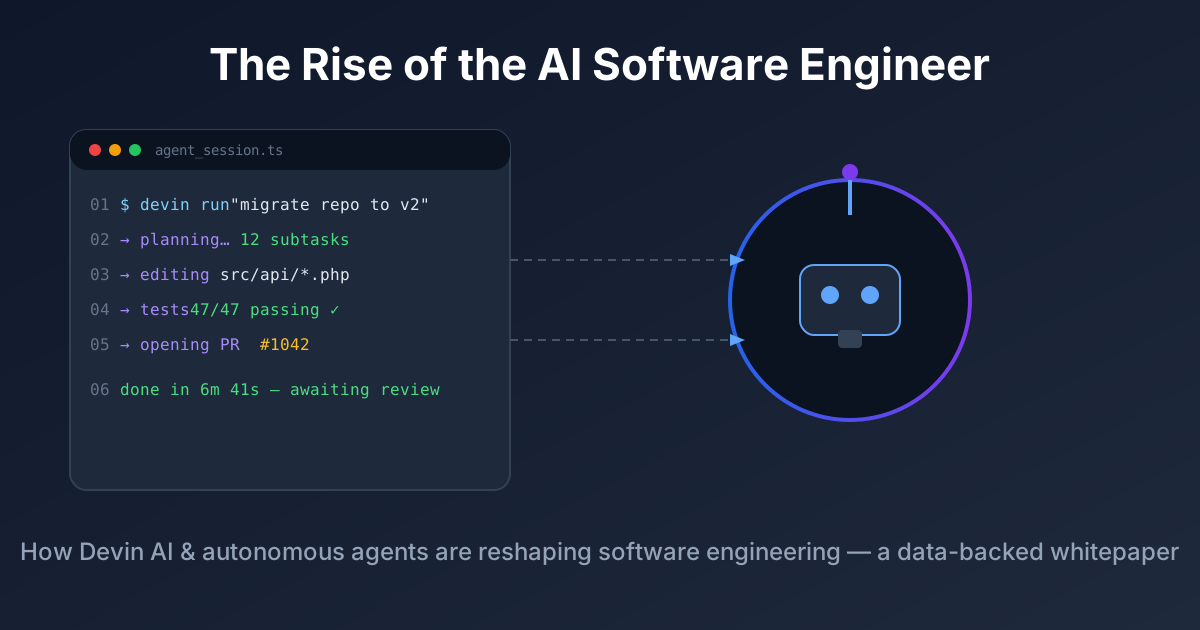
In March 2024, a startup called Cognition released a demo that made half the engineering world nervous: an AI system named Devin that could take a plain-English task, open a code editor, plan an approach, write code, run tests, debug its own failures, and hand back a finished pull request — largely without a human typing a single line. Two years later, "AI software engineers" are no longer a demo. They sit inside real teams at companies like Goldman Sachs, Santander and Nubank, and Cognition reports that Devin alone has merged hundreds of thousands of pull requests.
This whitepaper pulls together the most credible data we could find — benchmark results, large-scale developer surveys, controlled productivity trials, and labor-market studies — to answer the questions engineers actually ask: How good are these agents really? Where do they help and where do they fail? Is the junior-developer career path dead? And what should you do about it?
Executive Summary: The Eight Findings That Matter
- Adoption is near-universal. 84% of developers use or plan to use AI tools (Stack Overflow 2025, 49,000+ respondents), and over 97% of enterprise developers surveyed by GitHub have used AI coding tools at work.
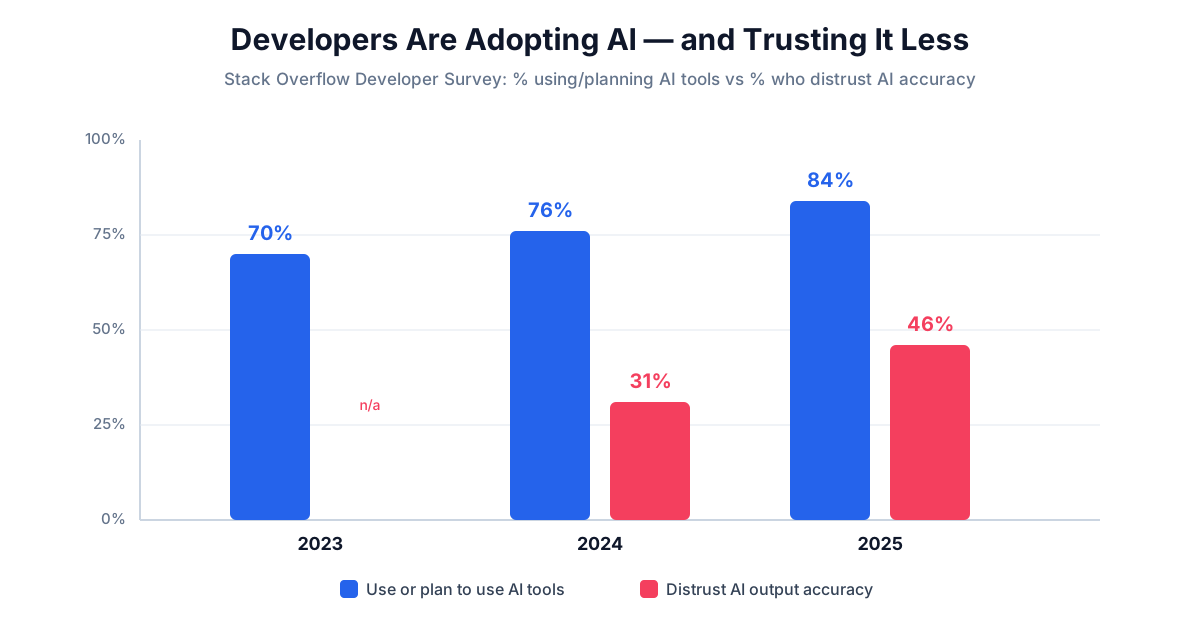
- Trust is falling while usage rises. Developers who actively distrust AI output jumped from 31% (2024) to 46% (2025). Experience teaches skepticism.
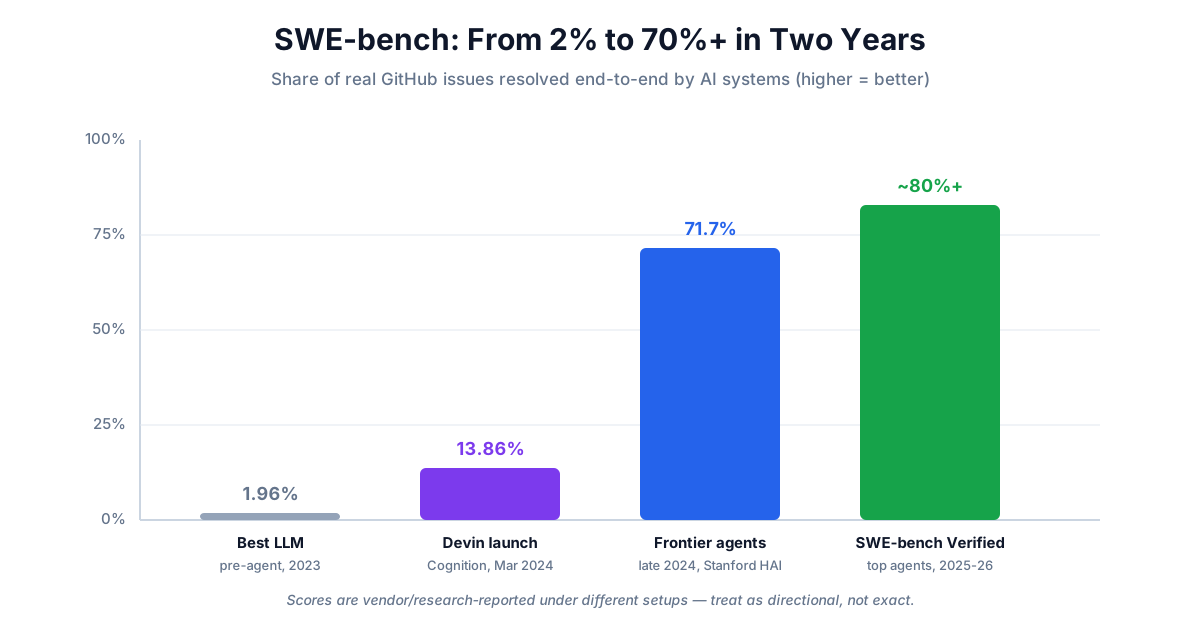
- Benchmarks improved ~35x in two years. Real GitHub-issue resolution went from ~2% (2023) to Devin's 13.86% at launch to 70%+ on SWE-bench-style leaderboards by late 2024/2025.
- A third of Big Tech code is already AI-touched. Google reports well over 30% of new code is AI-generated; Microsoft says 20-30% of code in its repos is AI-written.
- Productivity gains are real but conditional. A controlled GitHub study showed 55% faster task completion — yet a 2025 METR randomized trial found experienced developers were 19% slower on mature codebases they knew well.
- Agents shine on junior-shaped work. Clear specs, verifiable outcomes, 4-8 hours of scope: migrations, vulnerability fixes, test writing, small tickets.
- The entry-level squeeze is real. Stanford payroll data shows ~20% fewer employed developers aged 22-25 since the late-2022 peak, while senior employment held steady. BLS still projects ~16-18% growth for developers overall through 2033-34.
- The job is changing shape, not disappearing. Only ~20% of engineering time was ever spent writing code. The leverage is shifting to specification, review, architecture and orchestration.
1. From Autocomplete to Autonomy: How We Got Here
AI assistance for programmers has moved through four distinct phases, each one taking more of the workflow away from the human:
| Phase | Era | What the AI does | Human role | Examples |
|---|---|---|---|---|
| Autocomplete | 2021-22 | Suggests the next lines inside your editor | Types, accepts or rejects | Copilot v1, IntelliCode |
| Chat assistant | 2023 | Answers questions, generates snippets and explanations | Copies, adapts, integrates | ChatGPT, Copilot Chat, Gemini |
| Agentic IDE | 2024-25 | Edits multiple files, runs commands, iterates in your project | Supervises each step, approves diffs | Cursor, Copilot agent mode, Windsurf, Claude Code |
| Autonomous agent | 2024→ | Owns a task end-to-end: plan → code → test → PR | Delegates, reviews the result, decides to merge | Devin, Copilot coding agent, OpenAI Codex, Jules, Replit Agent |
Devin was the product that made phase four famous. Cognition positioned it not as a smarter autocomplete but as a teammate: it runs in its own cloud environment with a shell, editor and browser, and you interact with it the way you would with a remote contractor — assign work, check progress, comment on the output. The same pattern now exists across the industry: GitHub's Copilot coding agent takes assigned issues and returns PRs, OpenAI's Codex runs tasks in cloud sandboxes, and Google's Jules works asynchronously on your repos.
2. What "AI Software Engineer" Actually Means
An autonomous agent is a loop, not a chatbot. Given a goal with acceptance criteria, it plans, decomposes the task, writes and edits code across files, runs the tests, reads the failures, and iterates — checking its own work against the spec before a human ever sees it.
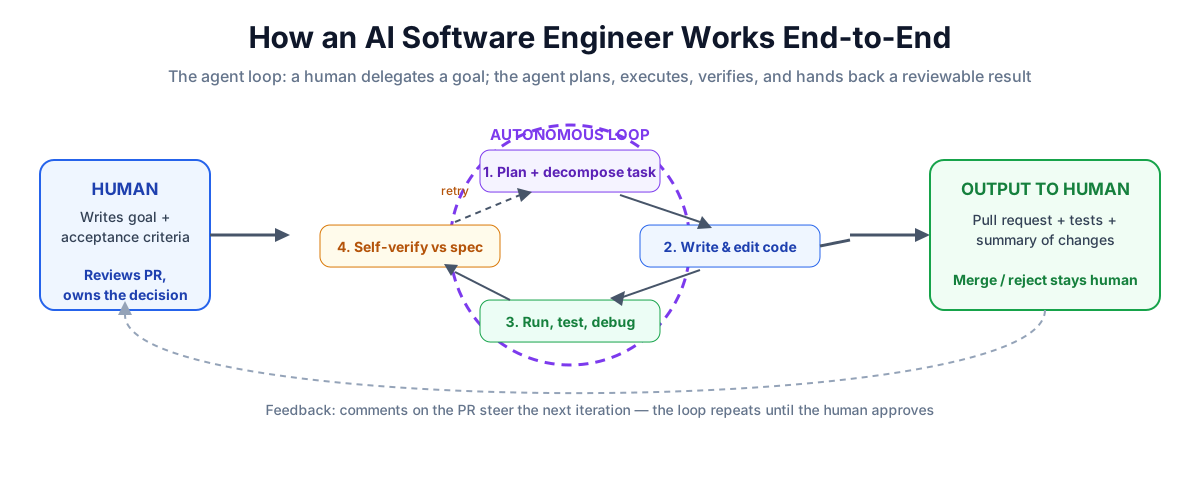
Two design choices separate real agents from marketing demos. First, tool access: the agent can execute shell commands, run builds, and read real error output — so it verifies rather than guesses. Second, feedback loops: when a test fails, the agent reads the failure and tries again, and a human can comment mid-flight to redirect it. This is why Cognition evaluates on SWE-bench — real GitHub issues where a fix only counts if the project's own test suite passes.
3. The Numbers: Benchmarks and Adoption
3.1 Capability: a 35x jump in two years
When Devin launched in March 2024, it resolved 13.86% of issues on SWE-bench (79 of 570 sampled issues) — modest in absolute terms, but a landslide versus the previous best unassisted result of 1.96%, and better than models that were handed the exact files to edit (4.80%). By late 2024, frontier systems were reporting ~71.7% on related evaluations (Stanford HAI AI Index), and top entries on the human-validated SWE-bench Verified leaderboard now report around 80%.
Cognition's own 2025 "performance review" of Devin gives a production-side view: 4x faster problem-solving than the launch version, 2x better resource efficiency, and a 67% PR merge rate — up from 34% the year before. That last number is arguably the most honest metric in the industry: two out of three pull requests the agent opens are now accepted by human reviewers.
3.2 Adoption: nearly universal, increasingly skeptical
Stack Overflow's 2025 survey (49,000+ developers) shows 84% of respondents use or plan to use AI tools — up from 76% in 2024 and 70% in 2023 — and 51% of professional developers use them daily. Yet the same survey records something the hype cycle hides: 46% of developers now say they distrust the accuracy of AI output, up from 31% the year before, and overall positive sentiment fell to about 60%.
Meanwhile at the top of the industry, AI-generated code is already a large share of what ships. Google CEO Sundar Pichai told investors in October 2024 that more than a quarter of new code at Google was AI-generated, a figure later reported as well over 30%. Microsoft CEO Satya Nadella put AI's share of code in Microsoft's repos at 20-30% in April 2025, and Microsoft's CTO has publicly predicted 95% of code will be AI-generated by 2030. Y Combinator reported that roughly a quarter of its Winter 2025 startups had ~95% AI-generated codebases.
4. Does It Actually Make Engineers Faster? The Honest Evidence
This is where the data gets uncomfortable — for both the hype and the doom narratives.
| Study | Method | Finding | Caveat |
|---|---|---|---|
| GitHub / MIT controlled study | 95 developers, timed task (HTTP server in JS) | 55% faster completion with Copilot | Greenfield task, not a mature codebase |
| McKinsey research | Field analysis of common dev tasks | Up to 2x faster on documentation, boilerplate, refactoring | Gains shrink on complex, novel work |
| METR randomized trial (2025) | 16 experienced OSS maintainers, 246 real issues on repos they knew deeply | 19% slower with AI allowed | Devs felt 20% faster — a perception gap; snapshot of early-2025 tools |
| DORA 2024 report | 39,000+ professionals | AI adoption linked to lower delivery stability and throughput in some measures | Correlation, and fast-moving baselines |
| Cognition production data | Devin PR outcomes across customers | 67% merge rate, up from 34% | Vendor-reported; task mix skews to agent-suitable work |
The synthesis that fits all of this: AI agents are fastest where the task is well-specified, verifiable, and boring — and slowest where success depends on deep context, taste, and ambiguity. The METR developers weren't slower because AI is useless; they were slower because prompting and reviewing costs time, and they already knew their 1M-line codebases better than any model. Put the same agent on an unfamiliar migration or a backlog of Dependabot-style fixes and the math flips — exactly where Cognition reports Devin performing best.
Where agents already outperform (and where they don't)
- Win: repo migrations and modernization, fixing known vulnerability classes, generating unit tests, small well-scoped tickets, docs, boilerplate, "4-8 hour junior tasks" with clear acceptance criteria.
- Lose: ambiguous requirements, novel architecture, cross-system trade-offs, performance tuning in unfamiliar territory, anything requiring organizational context or negotiation.
- Human-only (still): deployment and monitoring decisions (76% of devs won't delegate this), project planning (69%), and accountability for what ships.
5. The Labor Market: A Squeeze at the Bottom, Not a Collapse
The scariest charts floating around are real — but they measure the entry tier, not the profession.
Stanford's "Canaries in the Coal Mine" payroll study (Brynjolfsson, Chandar, Chen) found that in the most AI-exposed occupations, workers aged 22-25 saw about a 13% employment decline since late 2022 — and for software developers specifically, roughly 20% fewer young developers are employed than at the peak, while employment for experienced developers held flat or grew. An IZA study of near-universal U.S. vacancy data found a 14-15% relative decline in junior versus senior developer postings after ChatGPT's release — driven by employers demanding more experience inside the same job titles. Salesforce's CEO publicly paused new engineering hires for 2025 citing ~30% AI-driven productivity gains.
Yet the macro projections point the other way. The U.S. Bureau of Labor Statistics projects software developer employment to grow about 16-18% through 2033-34 — among the fastest-growing occupations — while the narrower "computer programmer" category (routine scripting work) is in genuine decline. The World Economic Forum still ranks software developers among the fastest-growing roles through 2030.
The reconciling insight: AI is eating the bottom of the task stack, not the occupation. The tasks that trained juniors — scaffolding, simple tickets, first-pass tests — are precisely the tasks agents do best. That raises the entry bar and changes what a "junior" is, which is a serious pipeline problem for the industry even while total demand grows.
6. The Real Risks Teams Are Hitting
- Verification debt. Code that "looks right" and passes shallow review can carry subtle defects. The 46% distrust figure exists because experienced devs have been burned.
- Security surface. Agents can reproduce vulnerable patterns, hallucinate dependencies (a real supply-chain vector: attackers publish packages under names models invent), and quietly widen permissions.
- Accountability gaps. When an agent's PR causes an incident, the human approver owns it — but many teams haven't adapted review standards to machine-speed output.
- Skill atrophy. If juniors never struggle through the easy bugs, where do tomorrow's seniors come from? Teams that outsource all debugging lose the muscle that catches agent mistakes.
- Measurement theater. "30% of our code is AI-generated" sounds impressive, but lines of code is a terrible proxy for value. Merge rates, rework rates, and incident rates tell the truth.
7. The Playbook: What to Actually Do
For individual engineers
- Move up the loop. Your durable skills are problem definition, system design, and verification. Practice writing specs an agent can't misinterpret — it's the new high-leverage skill.
- Learn to review at machine speed. Diff-reading, threat-modeling generated code, and designing test harnesses that actually catch agent errors are becoming core competencies.
- Use agents for breadth, keep depth human. Delegate the migrations and test-writing; personally own the architecture decisions and the gnarly debugging.
- Stay AI-fluent, not AI-dependent. 44% of developers now use AI to learn — use it to explore unfamiliar domains, but verify against docs and keep the ability to work unassisted.
- Build the receipts. A portfolio of "I orchestrated agents to ship X" is already a hiring signal; a portfolio of unreviewed generated code is a red flag.
For engineering teams and leaders
- Assign agents like work, not like search. Give clear specs, small scopes, and measurable acceptance criteria — the same conditions where they outperform.
- Measure outcomes, not usage. Track PR merge rate, rework, defect escape and cycle time — not "AI lines of code."
- Protect the junior pipeline deliberately. Pair juniors with agents and mentors; make verification skills part of onboarding.
- Add agent-specific guardrails. Dependency allow-lists, mandatory tests on generated code, least-privilege credentials for agent environments, human sign-off on deploys.
- Pilot on the boring backlog first. Migrations, vuln fixes, and test coverage are proven wins and the lowest-risk place to learn.
8. Outlook: 2026-2030
| Horizon | Likely development | Confidence |
|---|---|---|
| Now-2027 | Agents become standard issue on teams; "merged without human code edits" becomes a normal PR label; junior hiring stays tight while AI-fluent mid-level demand grows. | High |
| 2027-28 | Multi-agent workflows (planner + coder + reviewer agents) handle multi-day features; benchmark saturation pushes evaluation toward cost, reliability and maintainability. | Medium |
| 2028-30 | The majority of new code is machine-drafted (Microsoft's CTO already predicts 95% by 2030); human engineers concentrate on intent, architecture, integration and accountability. Whether "software engineer" headcount keeps growing depends on whether demand for software expands faster than agents expand output. | Speculative |
The honest bottom line from two years of data: Devin and its peers did not replace software engineers — they redefined what an engineer is. The profession is splitting less into "replaced vs. safe" and more into "engineers who direct AI" vs. "engineers who compete with it." History's safest bet is on the first group.
Key takeaways
- Autonomous agents are production-real: ~67% of Devin's PRs get merged, and SWE-bench-class scores went from ~2% to ~80% in two years.
- Adoption is 84% and climbing — but so is distrust (46%). Verification skills are the career moat.
- Productivity gains are conditional: huge on specified, verifiable work; negative on deep-context expert work.
- The crisis is concentrated at the entry level (-20% young-developer employment) even while the occupation grows overall.
- Winning strategy: become the person who specifies, reviews and orchestrates — not the person who types the fastest.
Frequently Asked Questions
Will AI replace software engineers?
The evidence so far says no — it is replacing tasks, not the occupation. BLS projects ~16-18% developer employment growth through 2033-34. But the entry-level version of the job is genuinely shrinking, and engineers whose value is only "writing code quickly" face the most pressure.
How good is Devin AI actually?
Cognition reports a 67% PR merge rate (up from 34% a year earlier) and best results on well-specified tasks that would take a junior engineer 4-8 hours: migrations, vulnerability fixes, unit tests, small tickets. It is senior-level at codebase understanding but junior-level at judgment — a tireless, infinitely parallel junior teammate, not a senior engineer.
What is SWE-bench and why does it matter?
SWE-bench tests whether an AI can resolve real GitHub issues from real projects — a fix only counts if the project's own tests pass. It's the closest thing the industry has to an honest engineering exam, which is why progress from ~2% to 70-80% in two years is significant.
Do AI tools actually make developers faster?
Sometimes dramatically (55% faster in GitHub's controlled study), sometimes negatively (19% slower in METR's trial with senior devs on familiar codebases). The pattern: gains are biggest on unfamiliar, well-specified, verifiable work — and shrink or invert on ambiguous, deep-context problems.
Should juniors still learn to code?
Yes — arguably more rigorously than before. When 46% of your colleagues distrust AI output, the people who can verify code are the valuable ones. Learn fundamentals deeply, then learn to orchestrate agents on top of them.
What should teams measure instead of "AI lines of code"?
PR merge rate, rework/defect-escape rate, cycle time, and incident rate. Volume of generated code is marketing; outcomes are engineering.
Sources: Cognition's SWE-bench technical report and Devin 2025 performance review; Stack Overflow Developer Surveys 2023-2025 (49,000+ respondents); GitHub developer survey (2,000 enterprise respondents) and Copilot controlled study; METR randomized controlled trial "Measuring the Impact of Early-2025 AI on Experienced Open-Source Developer Productivity"; Stanford "Canaries in the Coal Mine" payroll study; IZA junior-vacancy analysis (Lightcast data); U.S. Bureau of Labor Statistics projections; Alphabet and Microsoft executive disclosures; DORA 2024 report; WEF Future of Jobs. Vendor-reported figures are identified as such.