
For most of the last decade, "AI" meant a model you asked a question. In 2026 it increasingly means a model you hand a job. The three frontier labs now describe their flagship systems in the language of work rather than chat: OpenAI's GPT-5.6 is benchmarked on "long-running professional workflows across 55 fields"; Google's Gemini 3.5 is "frontier intelligence with action," built for "complex long-horizon tasks"; Anthropic reports a Claude Opus 5.5 tester completing a 680,000-line code migration in under a day. The unit of value has shifted from the answer to the completed task.
This guide is for people who want to understand that shift without the marketing gloss: what an agent actually is, how the three model families compare on the evaluations that measure agentic work, how "computer use" works under the hood, what the new agent platforms give you, and — most importantly — how to adopt this technology without getting burned.
Executive Summary
- The frontier is converged, not dominated. On agentic terminal coding (Terminal-Bench 2.1) the top three models are within one point of each other: Gemini 3.8 Flash 89.4%, Claude Opus 5 89.1%, GPT-5.6 Sol 88.8%.
- Computer use is the differentiator. On OSWorld-2.0, Claude Opus 5 leads at 75.4% versus GPT-5.6 Sol 62.6% and Gemini 3.8 Flash 59.0% — a large gap in a capability that unlocks legacy software.
- Cost per task is now the real battleground. OpenAI positions GPT-5.6 Sol on "performance per dollar" and its Terra/Luna tiers at a fraction of frontier cost; Google's Flash models rival flagships at ~4× the token speed; Anthropic cut Opus 5.5's running cost 40% versus Opus 5.
- Platforms have arrived. OpenAI's Agents API (hosted Codex harness + sandbox), Anthropic's Agent SDK and Managed Agents, and Google's Gemini Enterprise Agent Platform mean you no longer build the agent loop yourself. MCP is the shared tool protocol connecting them.
- Safety is now benchmarked too. Anthropic reports Opus 5.5 is "much less likely to take hard-to-reverse actions" and more resistant to prompt injection; external evaluators (including METR) tested it pre-release.
- The adoption pattern that works: bounded task, explicit acceptance criteria, sandbox with least privilege, cheap model first, measure completion and rework, then scale.
1. From Chatbot to Agent: What Changed
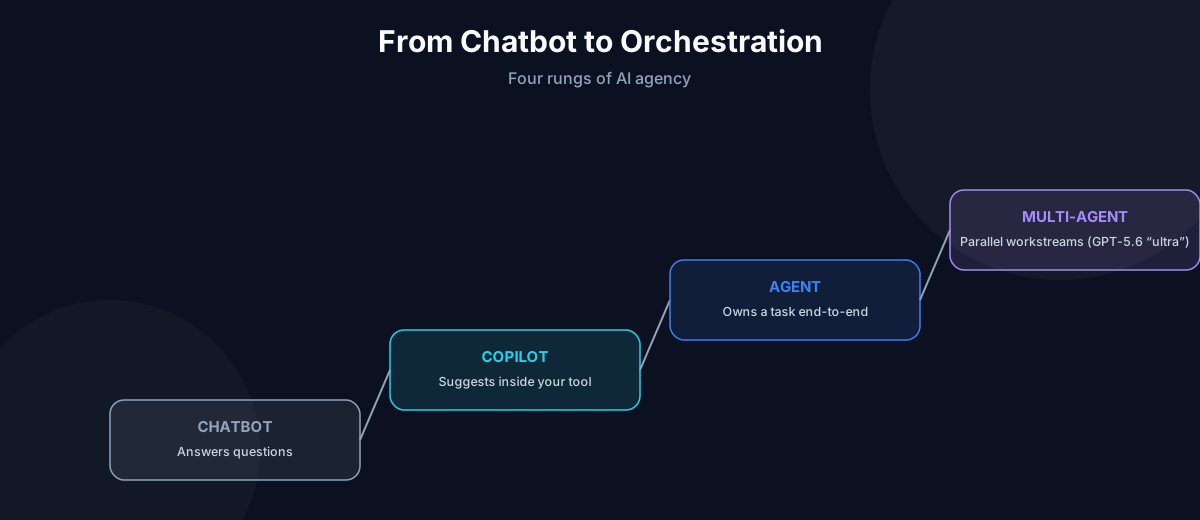
The vocabulary is loose, so let's fix it:
- A chatbot answers. One prompt, one response, no side effects.
- A copilot suggests inside a tool you're operating — code completions, draft replies. You stay in control of every action.
- An agent owns a task end-to-end. It plans, calls tools (browser, terminal, files, APIs), observes results, corrects course and delivers an outcome. You review the result, not each step.
- Multi-agent orchestration splits a task across parallel agents — OpenAI's GPT-5.6 "ultra" setting explicitly "coordinat[es] multiple agents across parallel workstreams," and Anthropic's Agent SDK exposes sub-agents as a first-class feature.
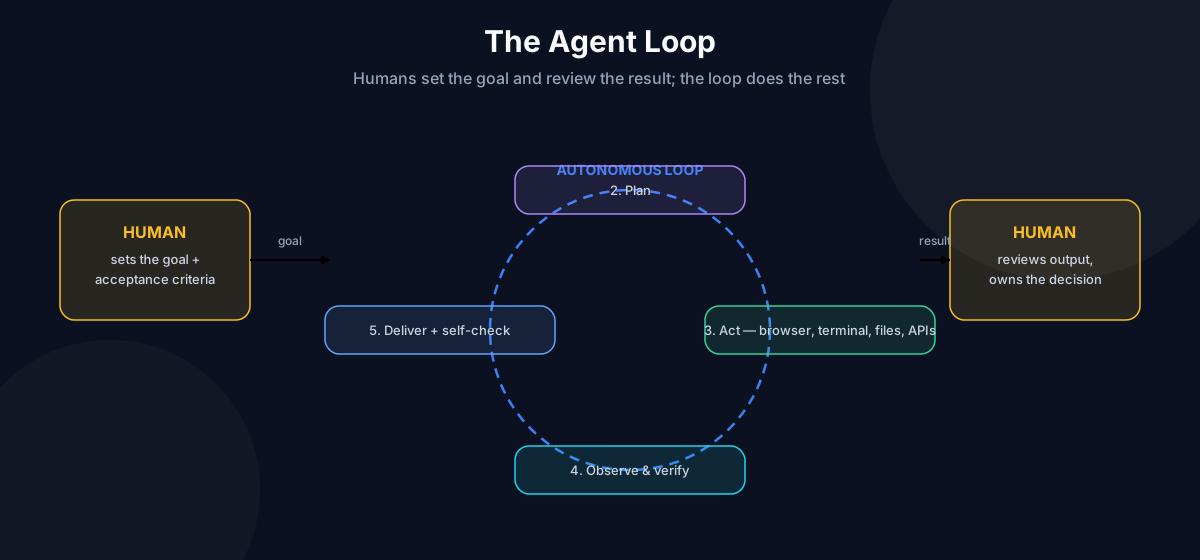
The crucial engineering ingredient is the harness — the code around the model that manages context, executes tools, handles errors and keeps state across hours or days. OpenAI is explicit that "useful agents need a powerful harness that manages context, uses tools efficiently, and coordinates subagents," and that they "need infrastructure that keeps them running reliably for days." The model is the brain; the harness is the nervous system.
2. The Three Model Families
OpenAI — GPT-5.6 (Sol, Terra, Luna)
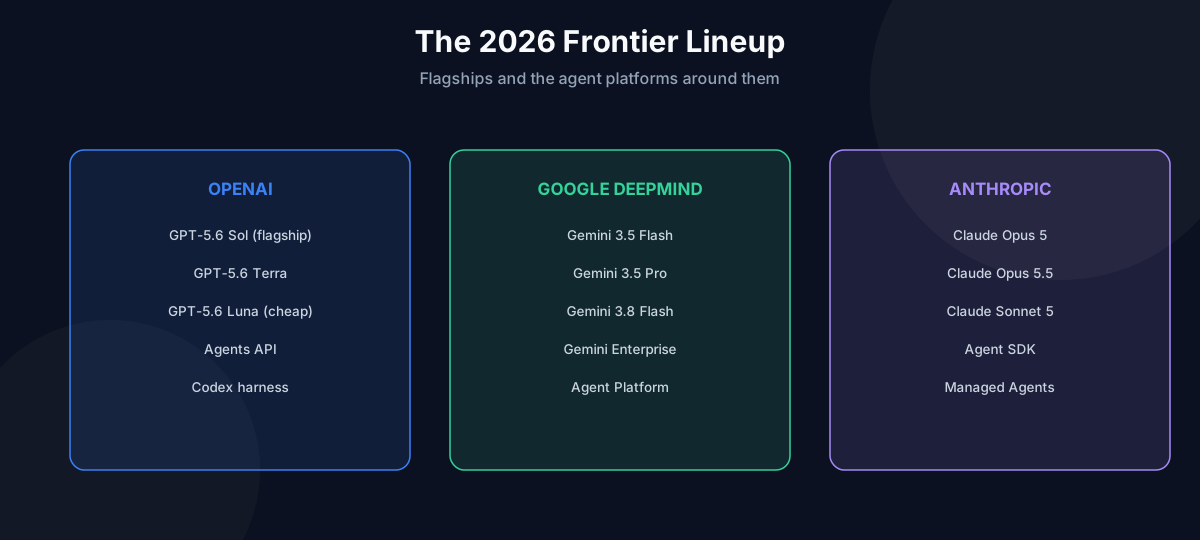
OpenAI's GPT-5.6 family ships as three tiers: Sol (flagship), Terra (balanced everyday model) and Luna (cost-efficient). The headline pitch is efficiency — "more useful work from every token." On OpenAI's own Agents' Last Exam, a benchmark of long-running professional workflows across 55 fields, Sol scores 53.6, which OpenAI says beats Claude Fable 5 by 13.1 points; at medium reasoning it claims a still-larger margin at roughly a quarter of the cost. Terra and Luna are positioned as outperforming last-generation frontier models at around one-sixteenth the cost. The new ultra setting fans work out to parallel agents.
Google DeepMind — Gemini 3.5 and 3.8
Gemini 3.5 launched at I/O 2026 with 3.5 Flash first, described as Google's "strongest agentic and coding model yet" — 76.2% on Terminal-Bench 2.1, 83.6% on MCP Atlas, 1656 Elo on GDPval-AA — with 3.5 Pro to follow. Google's distinctive angle is speed: 3.5 Flash outputs tokens about four times faster than other frontier models, "proving you no longer have to trade quality for latency." The rapidly iterated Gemini 3.8 Flash model card (the source for the cross-vendor comparisons below) pushes further into "software engineering and agentic knowledge workflows" and adds tunable effort levels.
Anthropic — Claude Opus 5 and 5.5, Sonnet 5
Claude Opus 5 is pitched as a "thoughtful and proactive" everyday model near the frontier at half the price of Anthropic's top tier; Anthropic reports state-of-the-art results on Frontier-Bench and GDPval-AA, a 3× lead on ARC-AGI 3 (novel problem solving), and ~1.5× the next-best pass rate on Zapier AutomationBench (end-to-end business tasks). Opus 5.5, the first of the 5.5 family, matches Anthropic's Fable 5.1 on most work while costing 40% less to run than Opus 5, and was externally evaluated before release. Anthropic frames it around reliability: one tester's 680,000-line migration in under a day; a 39-of-40 success rate cutting page load times without altering app behaviour.
3. The Benchmarks That Measure Agentic Work
Traditional benchmarks (MMLU, GSM8K) test knowledge. Agentic benchmarks test whether a model can finish a job. Three from Google's Gemini 3.8 Flash model card cover the three most economically important capabilities. All figures are vendor-reported; treat them as direction, not gospel.
3.1 Terminal coding
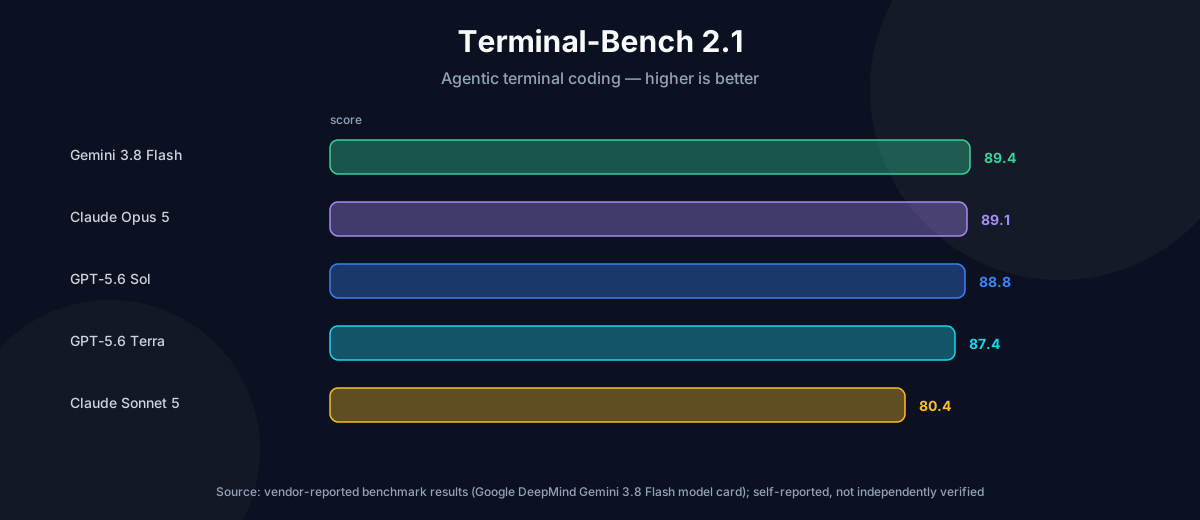
Terminal-Bench 2.1 asks a model to complete real tasks in a shell — install, configure, debug, script. The top three are effectively tied (89.4 / 89.1 / 88.8). Notably, mid-tier models are close behind: GPT-5.6 Terra at 87.4 shows how fast frontier capability trickles down to cheaper tiers.
3.2 Long-horizon software engineering
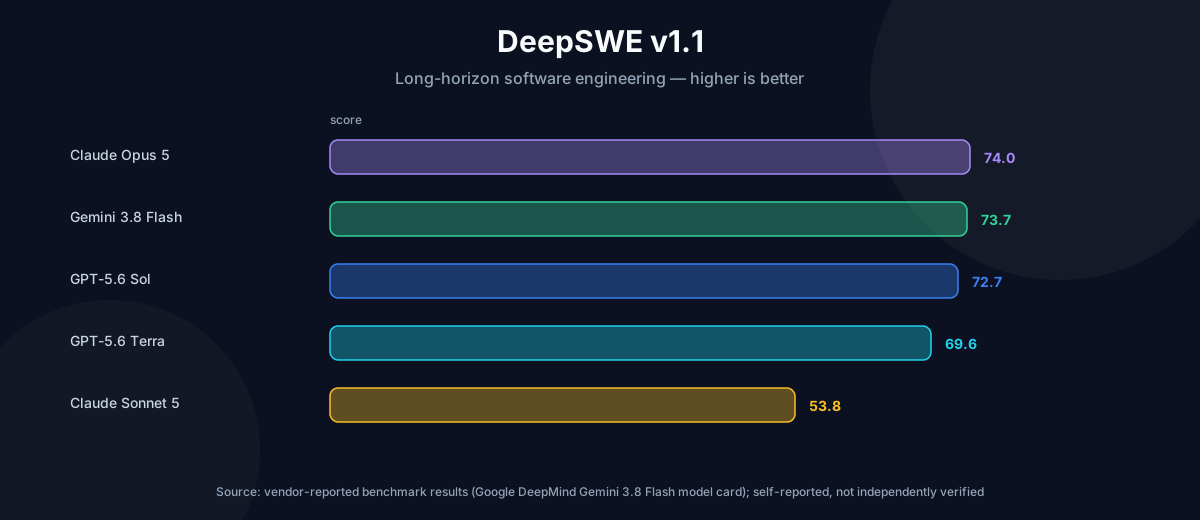
DeepSWE v1.1 measures multi-file, multi-step engineering work. Again the frontier trio sits within 1.3 points (74.0 / 73.7 / 72.7). The gap to Sonnet 5 (53.8) is the more instructive number: long-horizon coherence is where smaller models still fall away.
3.3 Computer use
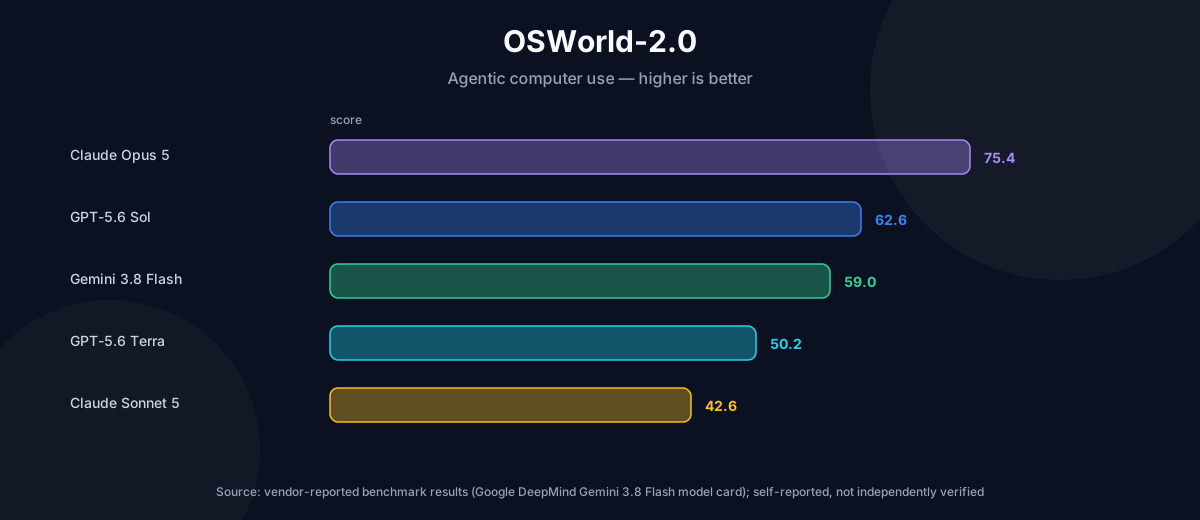
OSWorld-2.0 is the outlier: the model must operate a real desktop through screenshots and mouse/keyboard actions. Here Claude Opus 5 leads decisively at 75.4% versus 62.6% for GPT-5.6 Sol and 59.0% for Gemini 3.8 Flash. Computer use is the capability that lets agents reach software with no API — legacy ERP screens, internal tools, thick clients — so a 13-point lead is commercially meaningful. Anthropic has been building this capability since late 2024; it shows.
Two other rows from the same model card are worth a glance. On Harvey's Legal Agent Benchmark (complex legal workflows, all-pass rate) every model scores in single digits or barely above — 10.0% for Gemini 3.8 Flash — a reminder that "agent" does not yet mean "professional" in high-stakes domains. And on Terminal-bench 4.0 (general agent capabilities) Claude Opus 5 posts 51.8% against 37.3% for GPT-5.6 Sol and 19.1% for Gemini 3.8 Flash, suggesting substantial spread once tasks get open-ended.
4. Cost Is the New Capability
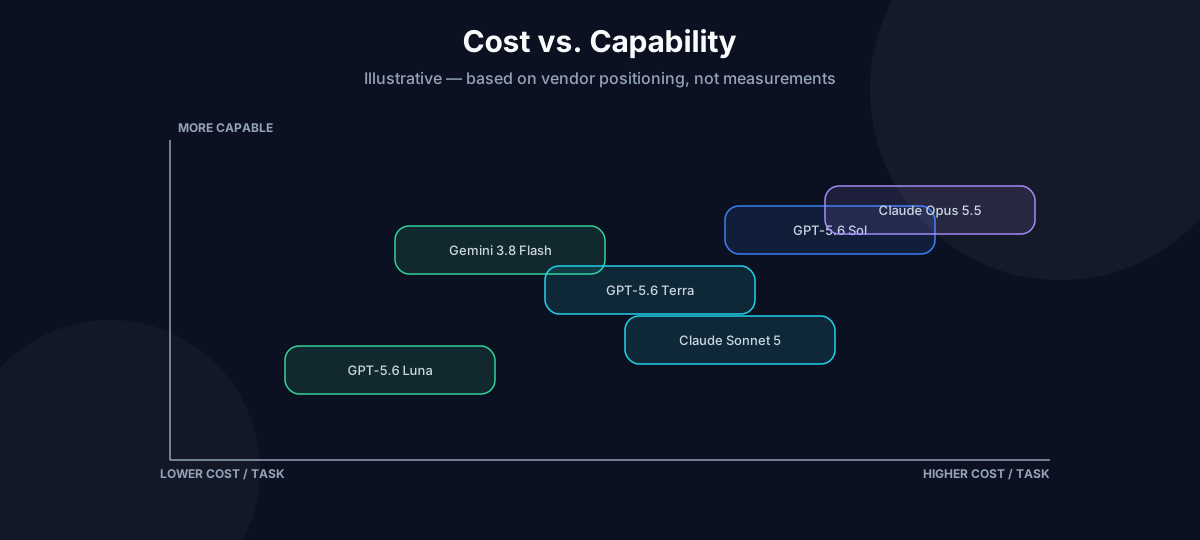
When three labs are within a point on capability, the decision moves to economics — and every vendor now leads with cost. OpenAI frames GPT-5.6 as "stronger performance per dollar: more successful work for the same spend"; on the Artificial Analysis index it claims Sol matches Claude Fable 5 within a point while finishing tasks in 61% less time at about half the estimated cost. Google's Flash line offers near-flagship intelligence at Flash speed, which for agents means more steps per minute and cheaper retries. Anthropic cut Opus 5.5's serving cost 40% and prices Opus 5 at half its top tier.
For a team, the implication is a routing strategy: use a cheap, fast model (Luna, Flash, Sonnet) for the 80% of steps that are simple, and escalate to a frontier model (Sol, Opus 5.5, Gemini Pro) only for the hard reasoning or when the cheap model fails verification. Most agent platforms now make this a configuration choice rather than an architecture project.
5. How Computer Use Actually Works
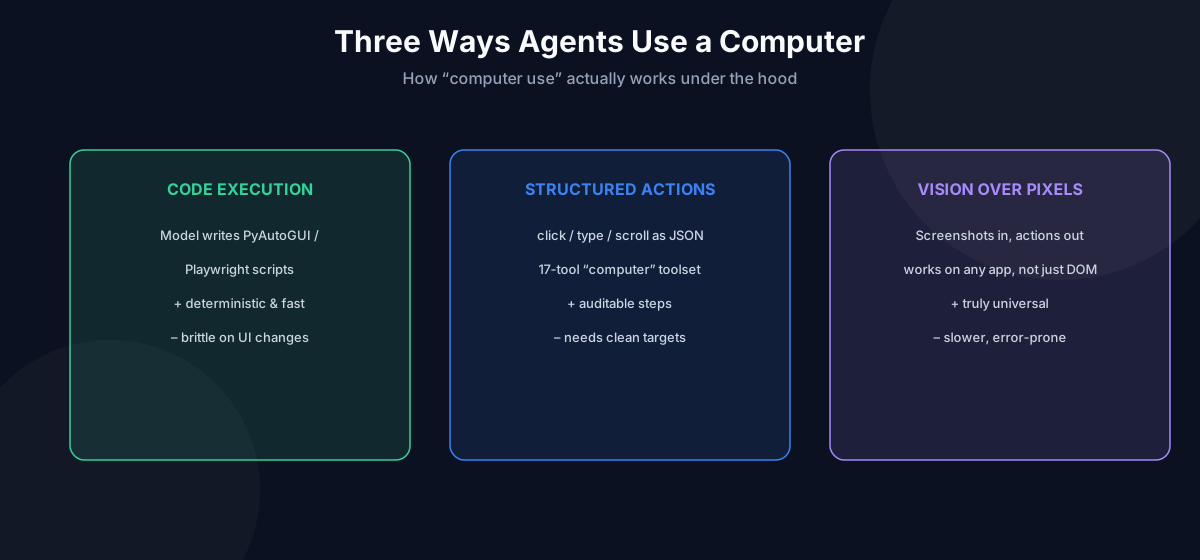
"Computer use" sounds magical; the mechanics are mundane and worth understanding, because they determine what can go wrong.
- Vision over pixels. The model receives a screenshot, reasons about what it sees, and decides on an action. Because it works from pixels rather than a web page's DOM, it can operate any application — a desktop installer, a spreadsheet, a legacy thick client. The cost is that every step ships an image, and images are expensive in tokens.
- Structured actions. Anthropic's current computer-use toolset exposes 17 member tools —
screenshot,left_click,type,zoomand so on — which the model calls, often several per turn; your application executes them in an environment you control. OpenAI'scomputertool returns similar mouse/keyboard actions. - Code execution. The newer pattern, and OpenAI's recommended one: the model writes a short script using PyAutoGUI or Playwright that batches actions, loops and conditionals into one call. Fewer round trips, fewer screenshots, cheaper and faster — but a wider blast radius per step.
In every mode, you provide the environment. The model never touches your machine directly; it emits intentions that your sandbox executes. That boundary is where all the safety engineering lives.
6. The Agent Platforms: You No Longer Build the Loop
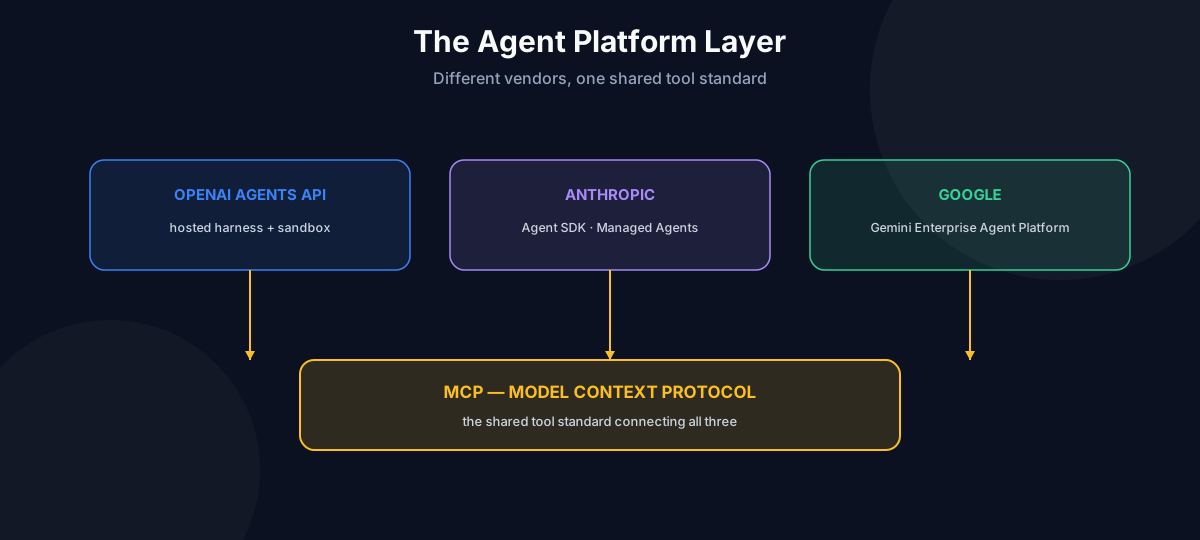
In 2024, building an agent meant writing the loop, the tool dispatcher, the retry logic and the sandbox yourself. In 2026 all three labs sell that as infrastructure:
- OpenAI Agents API (public beta) exposes the same harness that runs Codex and ChatGPT for Work: create an agent in a single call by specifying task, model, tools and environment. OpenAI hosts the harness; you pick the compute — an OpenAI-managed sandbox, your own infrastructure, or a partner sandbox — and agents can run "reliably for days."
- Anthropic Agent SDK gives you Claude Code's agent loop, context management, built-in tools, hooks, sub-agents and permission controls as a Python/TypeScript library running in your process. Managed Agents is the hosted alternative where Anthropic runs the agent and sandbox for you.
- Google Gemini Enterprise Agent Platform sits alongside Google AI Studio and Android Studio as the "agent-first development platform" for Gemini 3.5.
- MCP (Model Context Protocol) is the connective tissue: a standard way to expose tools and data sources that all three ecosystems support, so a tool you write once can serve agents from any vendor. Google even benchmarks on it (MCP Atlas).
7. Risks — and the Guardrails That Actually Work
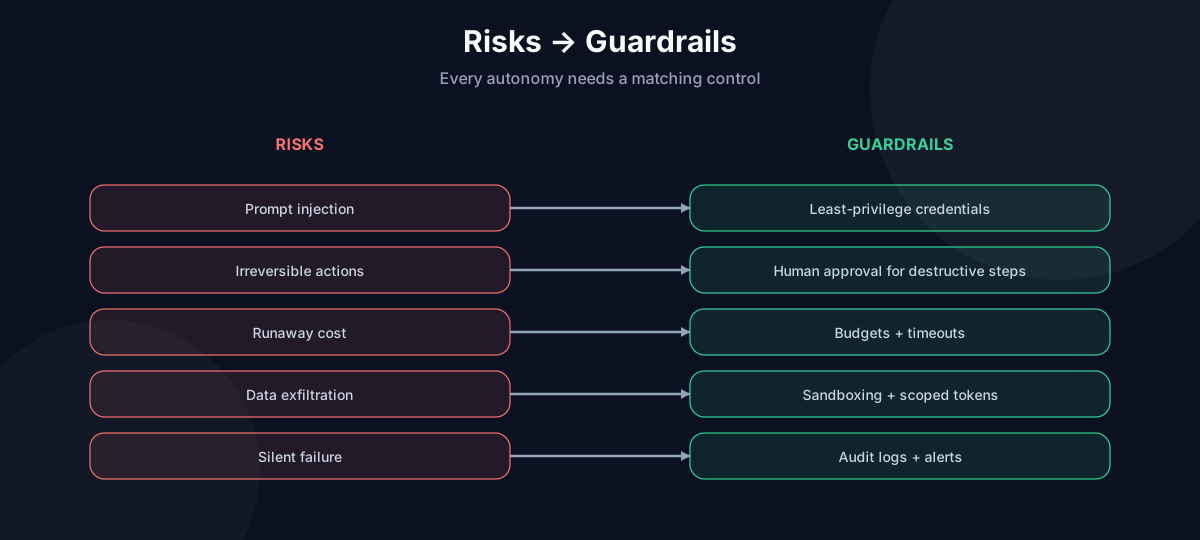
Agents fail differently from chatbots. A chatbot's worst case is a wrong answer; an agent's worst case is a wrong action — deleted data, an unwanted purchase, an email sent, a credential leaked. Five failure modes dominate:
- Prompt injection. An agent reading a web page or email can be instructed by its content. Anthropic now explicitly reports Opus 5.5 as "more resistant than Opus 5 to prompt injection" — that this is a headline safety metric tells you how real the problem is.
- Irreversible actions. Anthropic's automated behavioural audit specifically measures whether a model takes "hard-to-reverse actions or act[s] outside the boundaries it's been given." Your mitigation: require human approval for anything destructive, and give agents credentials that cannot do the irreversible thing.
- Runaway cost. A looping agent burning frontier tokens for hours is a real bill. Budgets, step limits and timeouts are non-negotiable.
- Data exfiltration. An agent with broad file and network access is a channel out. Sandbox it; restrict egress; log everything.
- Silent failure. The task "completes" but the result is subtly wrong. Verification — tests, checks, a second model, a human — must be part of the task definition, not an afterthought.
The encouraging trend is that safety is becoming measurable. Opus 5.5 was tested pre-release by external evaluators including METR, and Anthropic has broadened testing to "longer tasks, impossible tasks, and scenarios modeled on real incidents" — while admitting "it still has limits." Ask every vendor for the equivalent.
8. A Practical Adoption Playbook
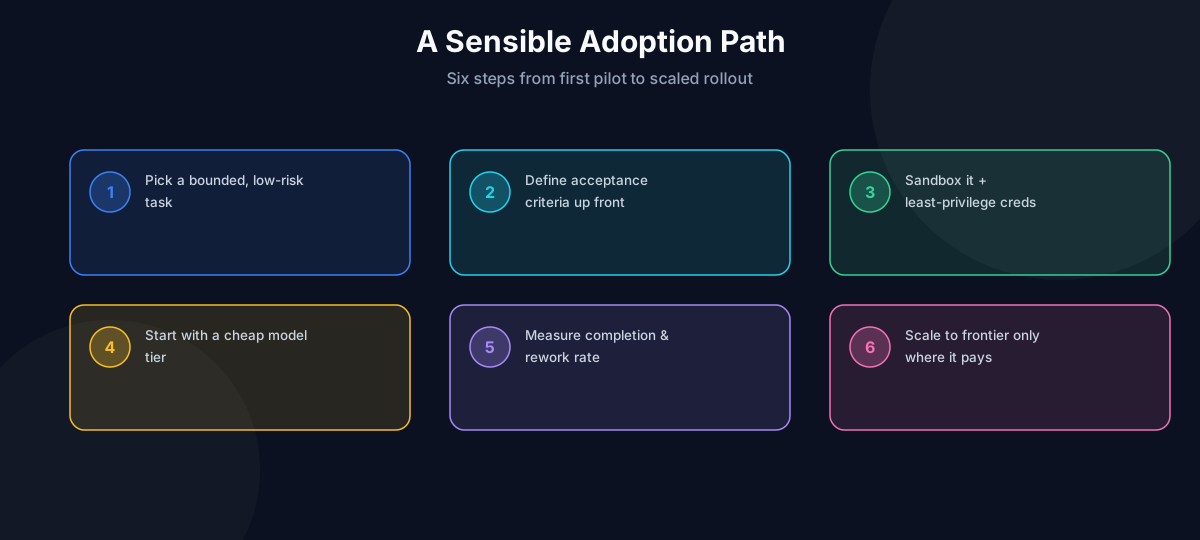
- Pick a bounded task with a verifiable outcome. Migrations, test writing, data reconciliation, report compilation, inbox triage. Avoid ambiguous judgement calls at first.
- Write acceptance criteria before you write the prompt. "Done" must be checkable by a script or a five-minute human review.
- Sandbox with least privilege. Separate credentials, no production write access, egress restricted, every action logged.
- Start with the cheap tier. Luna, Flash, Sonnet. Measure how often it passes your acceptance check.
- Measure completion rate and rework, not tokens. The number that matters is "tasks accepted without human fixes." OpenAI's 67%-style merge-rate metrics are the right shape.
- Escalate to frontier models where the maths works. If a $2 Sol run replaces a $20 human hour on a task the cheap model fails, route it up. If not, don't.
9. What to Expect Next
Three developments are visible on the near horizon. First, routing and orchestration become the product: features like GPT-5.6's ultra and the Agent SDK's sub-agents will make "a team of models" the default unit rather than one model. Second, computer use converges: the code-execution pattern will spread, and the OSWorld gap between vendors will narrow as everyone invests. Third, consumer agents go mainstream: Google's Gemini Spark already runs multi-week tasks for ordinary users by voice (see our Project Astra deep dive), and the enterprise patterns described here will look quaint once your phone assistant does the same thing.
Key takeaways
- On coding-agent benchmarks the frontier is a three-way tie; on computer use Claude Opus 5 leads by a wide margin.
- Cost per completed task, not raw capability, is the deciding factor — route cheap first, escalate when verified failure justifies it.
- Hosted harnesses (Agents API, Managed Agents, Gemini Enterprise) plus MCP mean you build tools and tasks, not agent loops.
- Agents fail by acting wrongly, so least privilege, approval gates, budgets and verification are the core architecture.
- Safety is now benchmarked (behavioural audits, external evaluators) — demand the numbers.
Frequently Asked Questions
Which is the best AI agent model in 2026?
There is no single winner. On agentic coding, Gemini 3.8 Flash, Claude Opus 5 and GPT-5.6 Sol are within a point (89.4 / 89.1 / 88.8 on Terminal-Bench 2.1). On computer use, Claude Opus 5 leads clearly (75.4% on OSWorld-2.0). On cost efficiency, each vendor's mid tier (Terra, Flash, Sonnet) is remarkably close to the frontier. Choose by task type and budget.
What is the difference between an AI agent and a chatbot?
A chatbot returns an answer. An agent takes a goal, plans steps, uses tools (browser, terminal, files, APIs), checks its own results and delivers a completed task — often running for hours or days. You review the outcome rather than direct each step.
What does "computer use" mean for an AI model?
The model operates a desktop or browser through screenshots and mouse/keyboard actions (or by writing a PyAutoGUI/Playwright script), so it can drive software that has no API. Your application executes the actions in a sandbox you control.
Do I need to build my own agent framework?
Not anymore. OpenAI's Agents API, Anthropic's Agent SDK and Managed Agents, and Google's Gemini Enterprise Agent Platform provide the loop, tools, context management and sandboxing. MCP lets you write tools once for all of them.
Are AI agents safe to give access to my systems?
Only with guardrails: least-privilege credentials, sandboxed execution, human approval for irreversible actions, spend and time limits, full logging, and verification built into the task. Vendors now publish safety metrics (behavioural audits, prompt-injection resistance, external evaluations) — use them in your selection.
Sources: OpenAI, "GPT-5.6: Frontier intelligence that scales with your ambition" and "Introducing the Agents API"; OpenAI API documentation, Computer use guide; Google, "Gemini 3.5: frontier intelligence with action" (May 19, 2026); Google DeepMind Gemini 3.8 Flash model card (cross-vendor benchmark table); Anthropic, "Introducing Claude Opus 5" and "Introducing Claude Opus 5.5"; Anthropic Agent SDK and Computer use tool documentation; Claude Platform docs. All benchmark figures are vendor-reported and identified as such.